Ch. 2 - Acids and Bases: Central to Understanding Organic Chemistry
Bruice - Organic Chemistry 8th Edition
Bruice8th EditionOrganic ChemistryISBN: 9780135213711Non è quello che usi tu?Cambia libro di testo
Capitolo 2, Problema 19c,d

Calculate the equilibrium constant for the acid–base reaction between the reactants in each of the following pairs:
c. CH3NH2 + H2O
d. CH3N+H3 + H2O

Guida verificata passo dopo passo
1
Identify the acid and base in the reaction. For part (c), CH3NH2 (methylamine) acts as a base, and H2O (water) acts as an acid. For part (d), CH3NH3+ (methylammonium ion) acts as an acid, and H2O acts as a base.
Write the chemical equations for the reactions. For part (c), the reaction is CH3NH2 + H2O ⇌ CH3NH3+ + OH⁻. For part (d), the reaction is CH3NH3+ + H2O ⇌ CH3NH2 + H3O⁺.
Determine the equilibrium constant expression (K_eq) for each reaction. For part (c), K_eq = ([CH3NH3+][OH⁻]) / ([CH3NH2][H2O]). For part (d), K_eq = ([CH3NH2][H3O⁺]) / ([CH3NH3+][H2O]).
Simplify the equilibrium constant expressions by recognizing that the concentration of water ([H2O]) is constant in dilute aqueous solutions. This allows you to use the base dissociation constant (K_b) for part (c) and the acid dissociation constant (K_a) for part (d).
Use the relationship between K_a and K_b for conjugate acid-base pairs: K_a × K_b = K_w, where K_w is the ionization constant of water (1.0 × 10⁻¹⁴ at 25°C). If needed, calculate K_a or K_b using this relationship to find the equilibrium constant for the given reactions.

Risposta video verificata per un problema simile:

Questa soluzione video è stata consigliata dai nostri tutor come utile per risolvere questo problema.
Durata del video:
8m

Concetti chiave

Ecco i concetti essenziali che devi comprendere per rispondere correttamente alla domanda.

Acid-Base Reactions

Acid-base reactions involve the transfer of protons (H+) between reactants. In these reactions, acids donate protons while bases accept them. Understanding the nature of the reactants, such as whether they are strong or weak acids or bases, is crucial for predicting the direction of the reaction and calculating the equilibrium constant.
Video consigliato:
02:49
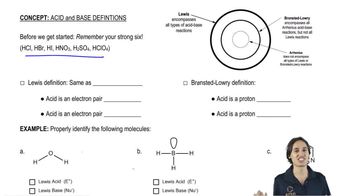
The Lewis definition of acids and bases.

Equilibrium Constant (K)

The equilibrium constant (K) quantifies the ratio of the concentrations of products to reactants at equilibrium for a given reaction. It is calculated using the formula K = [products]/[reactants], where the concentrations are raised to the power of their coefficients in the balanced equation. A higher K value indicates a greater tendency for the reaction to favor products.
Video consigliato:
02:19
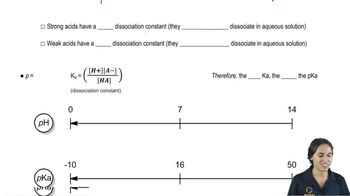
The relationship between equilibrium constant and pKa.

pKa and pKb Values

pKa and pKb values are measures of the strength of acids and bases, respectively. The pKa indicates the acidity of a compound, while pKb indicates the basicity. These values are essential for determining the equilibrium position of acid-base reactions, as they help predict which species will be favored at equilibrium based on their relative strengths.
Video consigliato:
07:45
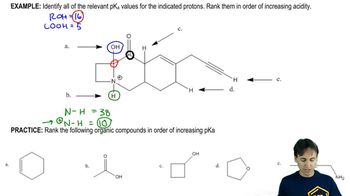
Identifying pKa values