Ch. 21 - Amino Acids, Peptides, and Proteins
Bruice - Organic Chemistry 8th Edition
Bruice8th EditionOrganic ChemistryISBN: 9780135213711Non è quello che usi tu?Cambia libro di testo
Capitolo 21, Problema 8b

Draw the predominant form for glutamate in a solution with the following
pH: b. 3

Guida verificata passo dopo passo
1
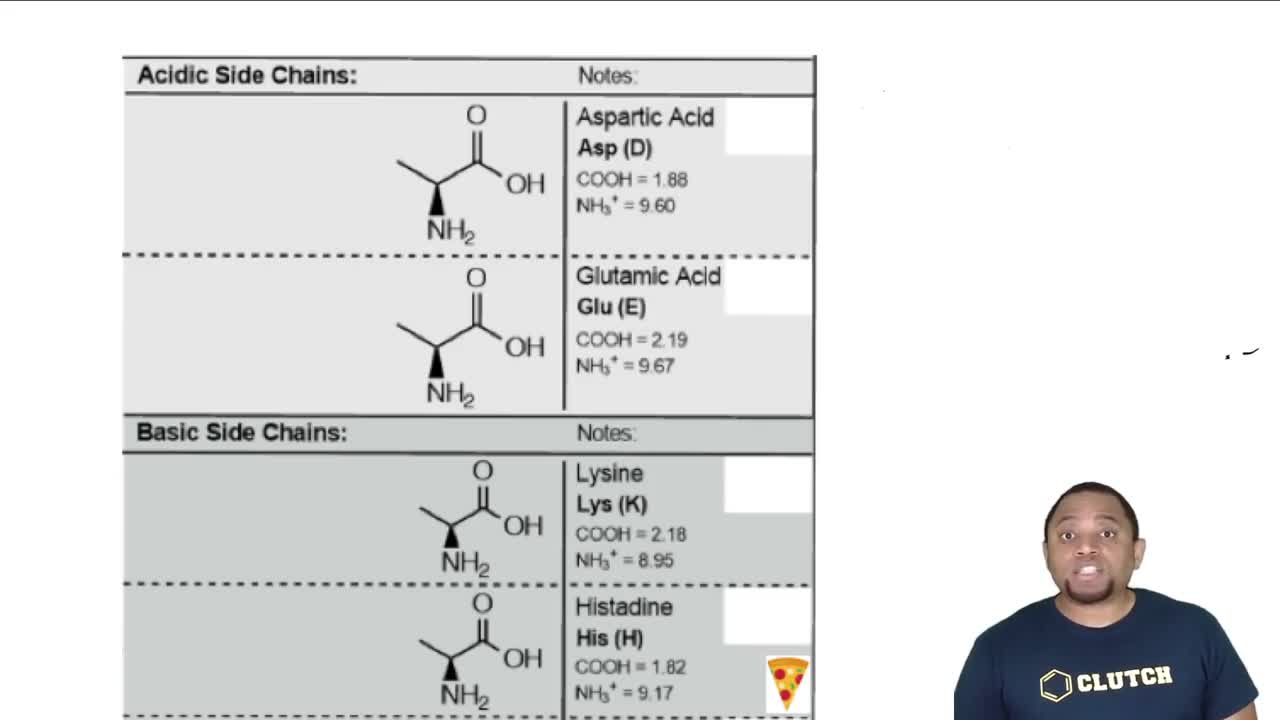
Determine the pKa values of the functional groups in glutamate. Glutamate has three ionizable groups: the α-carboxyl group (pKa ≈ 2.1), the α-amino group (pKa ≈ 9.5), and the side-chain carboxyl group (pKa ≈ 4.1).
Compare the pH of the solution (pH = 3) to the pKa of each functional group to determine their protonation states. If pH < pKa, the group will be protonated; if pH > pKa, the group will be deprotonated.
Analyze the α-carboxyl group (pKa ≈ 2.1): Since pH (3) > pKa (2.1), the α-carboxyl group will be deprotonated, forming a carboxylate ion (\( \text{COO}^- \)).
Analyze the side-chain carboxyl group (pKa ≈ 4.1): Since pH (3) < pKa (4.1), the side-chain carboxyl group will remain protonated as \( \text{COOH} \).
Analyze the α-amino group (pKa ≈ 9.5): Since pH (3) < pKa (9.5), the α-amino group will remain protonated as \( \text{NH}_3^+ \). Combine these observations to draw the predominant form of glutamate at pH 3.

Risposta video verificata per un problema simile:

Questa soluzione video è stata consigliata dai nostri tutor come utile per risolvere questo problema.
Durata del video:
5m

Concetti chiave

Ecco i concetti essenziali che devi comprendere per rispondere correttamente alla domanda.

Amino Acid Structure

Amino acids, the building blocks of proteins, consist of a central carbon atom bonded to an amino group, a carboxyl group, a hydrogen atom, and a variable R group. Glutamate, specifically, has a side chain that contains a carboxyl group, making it an acidic amino acid. Understanding the structure of glutamate is essential for predicting its behavior in different pH environments.
Video consigliato:
7:19
Charged Amino Acids

pH and Protonation States

pH is a measure of the acidity or basicity of a solution, influencing the protonation state of molecules. At low pH (like 3), amino acids can exist in their protonated forms, where the carboxyl group is likely to be protonated (–COOH) and the amino group remains protonated (–NH3+). This affects the overall charge and predominant form of glutamate in solution.
Video consigliato:
03:08
Ground vs. Excited States

Zwitterions

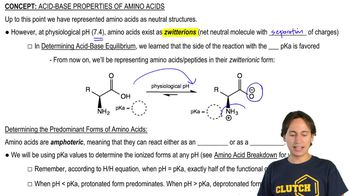
Zwitterions are molecules that have both positive and negative charges but are overall neutral. In the context of amino acids, at physiological pH, they often exist as zwitterions. However, at a low pH like 3, glutamate will predominantly exist in a protonated form, which is crucial for understanding its behavior in biochemical processes and interactions.
Video consigliato:
04:41
Why Amino Acids Exist as Zwitterions