
Ch. 21 - Amino Acids, Peptides, and Proteins
Bruice - Organic Chemistry 8th Edition
Bruice8th EditionOrganic ChemistryISBN: 9780135213711Non è quello che usi tu?Cambia libro di testo
Capitolo 21, Problema 46

How would a protein that resides in the nonpolar interior of a membrane fold compared with the water-soluble protein just discussed?

Guida verificata passo dopo passo
1
Understand the environment: A protein residing in the nonpolar interior of a membrane is exposed to a hydrophobic (nonpolar) environment, unlike a water-soluble protein, which is surrounded by a polar (aqueous) environment. This difference in surroundings will influence the folding and structure of the protein.
Analyze the role of hydrophobic and hydrophilic residues: In a membrane protein, the hydrophobic (nonpolar) amino acid residues will be oriented outward to interact with the nonpolar lipid bilayer, while the hydrophilic (polar) residues will be buried or located in regions that interact with the aqueous environment (e.g., at the membrane surface or in channels).
Consider secondary structure elements: Membrane proteins often adopt specific secondary structures, such as α-helices or β-barrels, that allow their hydrophobic side chains to face outward and interact with the lipid bilayer. These structures also help stabilize the protein in the membrane environment.
Compare with water-soluble proteins: In contrast, water-soluble proteins fold in a way that places hydrophilic residues on the exterior to interact with water, while hydrophobic residues are buried in the protein's core to avoid contact with the aqueous environment. This is the opposite of the folding pattern seen in membrane proteins.
Relate to function: The folding of a membrane protein is not only influenced by the environment but also by its function. For example, if the protein forms a channel or pore, it may have hydrophilic residues lining the interior of the channel to allow the passage of polar molecules, while the exterior remains hydrophobic to interact with the membrane.

Risposta video verificata per un problema simile:

Questa soluzione video è stata consigliata dai nostri tutor come utile per risolvere questo problema.
Durata del video:
2m

Concetti chiave

Ecco i concetti essenziali che devi comprendere per rispondere correttamente alla domanda.

Protein Folding

Protein folding is the process by which a polypeptide chain acquires its functional three-dimensional structure. This process is influenced by the sequence of amino acids and their interactions, including hydrophobic and hydrophilic interactions. In the case of membrane proteins, the folding is adapted to accommodate the nonpolar environment of the membrane, often resulting in the formation of alpha-helices or beta-barrels.
Video consigliato:
Percorso guidato
1:17
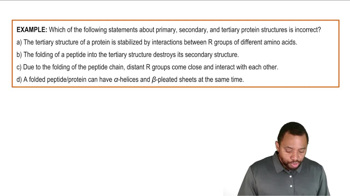
Tertiary Protein Structure Example 1

Hydrophobic and Hydrophilic Interactions

Hydrophobic interactions occur between nonpolar molecules or regions of molecules that tend to avoid water, while hydrophilic interactions involve polar molecules that interact favorably with water. In membrane proteins, hydrophobic regions typically reside within the lipid bilayer, while hydrophilic regions are exposed to the aqueous environment, influencing how the protein folds and functions within the membrane.
Video consigliato:
Percorso guidato
2:41
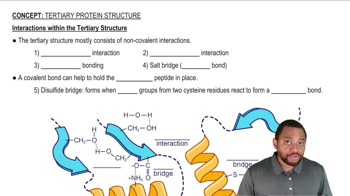
Interactions within the Tertiary Structure Concept 2

Membrane Structure

Cell membranes are primarily composed of a phospholipid bilayer, which creates a nonpolar interior that separates the internal cellular environment from the external surroundings. This structure is crucial for the function of membrane proteins, which must adapt their folding patterns to interact appropriately with both the hydrophobic core of the membrane and the aqueous environments on either side.
Video consigliato:
03:04
Drawing Resonance Structures
Pratica correlata
Domanda del libro di testo

Show the peptides that would result from cleavage by the indicated reagent: 

a. Val-Arg-Gly-Met-Arg-Ala-Ser by carboxypeptidase A

b. Ser-Phe-Lys-Met-Pro-Ser-Ala-Asp by cyanogen bromide

c. Arg-Ser-Pro-Lys-Lys-Ser-Glu-Gly by trypsin

1020
views
Domanda del libro di testo

Three peptides were obtained from a trypsin digestion of two different polypeptides. In each case, indicate the possible sequences from the given data and tell what further experiment should be carried out in order to determine the primary structure of the polypeptide.

a. polypeptide I:

1. Val-Gly-Asp-Lys

2. Leu-Glu-Pro-Ala-Arg

3. Ala-Leu-Gly-Asp

1063
views
Domanda del libro di testo

Glycine has pKa values of 2.34 and 9.60. At what pH does glycine exist in the forms shown?

a.

4856
views
Domanda del libro di testo

Which has a higher percentage of negative charge at physiological pH (7.4), leucine with pI = 5.98 or asparagine with pI = 5.43?

1286
views
Domanda del libro di testo

A decapeptide undergoes partial hydrolysis to give peptides whose amino acid compositions are shown. Reaction of the intact decapeptide with Edman's reagent releases PTH-Gly. What is the sequence of the decapeptide?

1. Ala, Trp

2. Val, Pro, Asp

3. Pro, Val

4. Ala, Glu

5. Trp, Ala, Arg

6. Arg, Gly

7. Glu, Ala, Leu

8. Met, Pro, Leu, Glu

1591
views
Domanda del libro di testo

Indicate the peptides produced from cleavage by the indicated reagent:

a. His-Lys-Leu-Val-Glu-Pro-Arg-Ala-Gly-Ala by trypsin

b. Leu-Gly-Ser-Met-Phe-Pro-Tyr-Gly-Val by chymotrypsin

2141
views