

Although metal ions increase the rate of decarboxylation of dimethyloxaloacetate, they have no effect on the rate of decarboxylation of either the monoethyl ester of dimethyloxaloacetate or acetoacetate. Explain why this is so.
Ch. 22 - Catalysis in Organic Reactions and in Enzymatic Reactions
Tutti i libri di testo
Bruice 8th Edition
Ch. 22 - Catalysis in Organic Reactions and in Enzymatic Reactions
Problema 6a
Bruice 8th Edition
Ch. 22 - Catalysis in Organic Reactions and in Enzymatic Reactions
Problema 6aCapitolo 22, Problema 6a
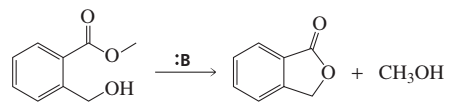
a. Draw the mechanism for the following reaction if it involves specific-base catalysis.

Guida verificata passo dopo passo1
Identify the reactants and the product in the reaction. Specific-base catalysis means that the reaction is catalyzed by a base (e.g., OH⁻, a deprotonated species) and not by the solvent itself. This will guide the mechanism.
Determine the functional groups in the reactant that are likely to interact with the base. For example, if the reactant contains an acidic proton (e.g., on an alcohol, carboxylic acid, or alpha-carbon of a carbonyl group), the base will abstract this proton.
Draw the first step of the mechanism: the base abstracts the acidic proton, forming a conjugate base of the reactant. Represent this step using curved arrows to show the movement of electrons. For example, the lone pair on the base attacks the acidic hydrogen, and the bond between the hydrogen and the reactant breaks, leaving the electrons on the reactant.
Illustrate the intermediate formed after the proton abstraction. This intermediate is often a negatively charged species (e.g., an enolate ion if the reactant is a carbonyl compound). Ensure that the structure of the intermediate is drawn correctly, showing all lone pairs and charges.
Complete the mechanism by showing how the intermediate reacts to form the final product. This could involve nucleophilic attack, elimination, or rearrangement, depending on the reaction. Use curved arrows to depict the electron flow in this step, and ensure that the product is consistent with the reaction conditions and specific-base catalysis.

Risposta video verificata per un problema simile:
Questa soluzione video è stata consigliata dai nostri tutor come utile per risolvere questo problema.
Durata del video:
2mConcetti chiave
Ecco i concetti essenziali che devi comprendere per rispondere correttamente alla domanda.
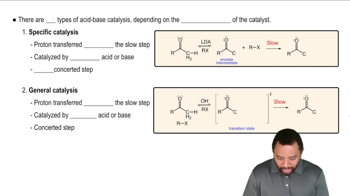
Specific-Base Catalysis
Specific-base catalysis refers to a reaction mechanism where a base, often a specific ion or molecule, facilitates the reaction by abstracting a proton (H+) from a substrate. This process lowers the activation energy required for the reaction to proceed, thereby increasing the reaction rate. Understanding this concept is crucial for analyzing how the base interacts with the reactants and influences the overall mechanism.
Video consigliato:
Percorso guidato
Acid-Base Catalysis Concept 3
Reaction Mechanism
A reaction mechanism is a step-by-step description of the pathway taken by reactants to form products in a chemical reaction. It includes the sequence of elementary steps, intermediates, and transition states involved. Drawing the mechanism helps visualize how bonds are broken and formed, providing insight into the kinetics and thermodynamics of the reaction.
Video consigliato:
Heck Reaction Mechanism
Proton Transfer
Proton transfer is a fundamental process in organic chemistry where a proton (H+) is transferred from one molecule to another. This process is often a key step in acid-base reactions and can significantly influence the stability of intermediates and the overall reaction pathway. Understanding proton transfer is essential for predicting the behavior of reactants under specific catalytic conditions.
Video consigliato:
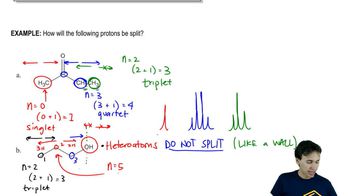
Proton Splitting
Pratica correlata
Domanda del libro di testo
1393
views
Domanda del libro di testo
Draw the mechanism if it involves general-acid catalysis.
937
views
Domanda del libro di testo
The relative rate of reaction for the cis alkene (E) is given in Table 22.2. What do you expect the relative rate of reaction for the trans alkene to be?
1239
views
Domanda del libro di testo
Draw the mechanism for the following reaction if it involves specific-acid catalysis.
1054
views
Domanda del libro di testo
Compare each of the mechanisms listed here with the mechanism for each of the two parts of the acid-catalyzed hydrolysis of an ester, indicating a. similarities. b. differences.
1. acid-catalyzed formation of a hydrate
811
views
Domanda del libro di testo
Show all the products, including their configurations, that are obtained from the above reaction.
1023
views