
Ch. 22 - Catalysis in Organic Reactions and in Enzymatic Reactions
Bruice - Organic Chemistry 8th Edition
Bruice8th EditionOrganic ChemistryISBN: 9780135213711Non è quello che usi tu?Cambia libro di testo
Capitolo 22, Problema 42

Proof that an imine was formed between aldolase and its substrate was obtained by using D-fructose-1,6-bisphosphate labeled at the C-2 position with 14C as the substrate. NaBH4 was added to the reaction mixture. A radioactive product was isolated from the reaction mixture and hydrolyzed in an acidic solution. Draw the structure of the radioactive product obtained from the acidic solution. (Hint: NaBH4 reduces an imine linkage.)

Guida verificata passo dopo passo
1
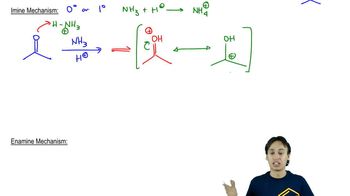
Understand the reaction mechanism: The problem involves the formation of an imine intermediate between aldolase and its substrate, D-fructose-1,6-bisphosphate, labeled with 14C at the C-2 position. Imine formation occurs when a primary amine reacts with a carbonyl group, resulting in a C=N bond.
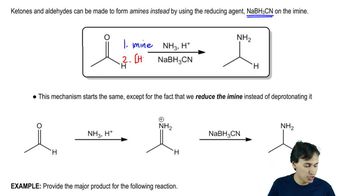
Recognize the role of NaBH4: Sodium borohydride (NaBH4) is a reducing agent that specifically reduces imines (C=N) to amines (C-N). This reduction step is crucial for stabilizing the intermediate and isolating the product.
Predict the radioactive product after NaBH4 reduction: After NaBH4 reduces the imine, the resulting product will have a C-N bond at the position where the imine was formed. The 14C label at the C-2 position will remain intact, as the reduction does not affect the carbon labeling.
Understand the hydrolysis step: The hydrolysis in acidic solution will cleave the bond between the enzyme and the substrate, releasing the reduced substrate as the final product. The structure of the product will include the reduced amine group and the intact D-fructose-1,6-bisphosphate backbone with the 14C label at C-2.
Draw the structure of the final product: The final product will be D-fructose-1,6-bisphosphate with a reduced amine group at the position where the imine was formed. Ensure the 14C label is clearly indicated at the C-2 position in the structure.

Risposta video verificata per un problema simile:

Questa soluzione video è stata consigliata dai nostri tutor come utile per risolvere questo problema.
Durata del video:
7m

Concetti chiave

Ecco i concetti essenziali che devi comprendere per rispondere correttamente alla domanda.

Imine Formation

Imine formation occurs when a carbonyl compound, such as an aldehyde or ketone, reacts with an amine, resulting in the creation of a C=N bond. This reaction is typically facilitated by the removal of water, which drives the equilibrium towards imine formation. Understanding this process is crucial for analyzing the reaction between aldolase and its substrate, as the formation of an imine is a key step in the mechanism.
Video consigliato:
06:23
Imine Mechanism

Reduction with NaBH4

Sodium borohydride (NaBH4) is a selective reducing agent commonly used in organic chemistry to reduce carbonyl compounds, including imines, to their corresponding amines. In the context of the question, NaBH4 reduces the imine linkage formed between aldolase and the substrate, leading to the formation of a stable amine product. This reduction is essential for understanding the transformation of the imine into a detectable product.
Video consigliato:
07:12
Reductive Amination

Radioactive Labeling

Radioactive labeling involves incorporating a radioactive isotope, such as 14C, into a molecule to trace its path through a chemical reaction. In this case, d-fructose-1,6-bisphosphate is labeled at the C-2 position, allowing researchers to track the formation of the radioactive product. This technique is vital for confirming the structure of the product and understanding the reaction mechanism, as it provides a means to identify and isolate specific compounds.
Video consigliato:
04:56
Electron Configurations of Transition Metals
Pratica correlata
Domanda del libro di testo

Triosephosphate isomerase (TIM) catalyzes the conversion of dihydroxyacetone phosphate to glyceraldehyde-3-phosphate. The enzyme’s catalytic groups are Glu 165 and His 95. In the first step of the reaction, these catalytic groups function as a general-base and a general-acid catalyst, respectively. Propose a mechanism for the reaction.

1317
views
1
rank
Domanda del libro di testo

2-Acetoxycyclohexyl tosylate reacts with acetate ion to form 1,2-cyclohexanediol diacetate. The reaction is stereospecific—that is, the stereoisomers obtained as products depend on the stereoisomer used as a reactant. Recall that because 2-acetoxycyclohexyl tosylate has two asymmetric centers, it has four stereoisomers—two are cis and two are trans. Explain the following observations:

b. Both trans reactants form the same racemic mixture.

1168
views
Domanda del libro di testo

3-Amino-2-oxindole catalyzes the decarboxylation of a-keto acids.

a. Propose a mechanism for the catalyzed reaction.

1131
views
Domanda del libro di testo

2-Acetoxycyclohexyl tosylate reacts with acetate ion to form 1,2-cyclohexanediol diacetate. The reaction is stereospecific—that is, the stereoisomers obtained as products depend on the stereoisomer used as a reactant. Recall that because 2-acetoxycyclohexyl tosylate has two asymmetric centers, it has four stereoisomers—two are cis and two are trans. Explain the following observations:

c. A trans reactant is more reactive than a cis reactant.

1172
views
Domanda del libro di testo

Explain why the alkyl halide shown here reacts much more rapidly with guanine than does a primary alkyl halide (such as pentyl chloride).

1081
views
Domanda del libro di testo

2-Acetoxycyclohexyl tosylate reacts with acetate ion to form 1,2-cyclohexanediol diacetate. The reaction is stereospecific—that is, the stereoisomers obtained as products depend on the stereoisomer used as a reactant. Recall that because 2-acetoxycyclohexyl tosylate has two asymmetric centers, it has four stereoisomers—two are cis and two are trans. Explain the following observations:

a. Both cis reactants form an optically active trans product, but each cis reactant forms a different trans product.

2114
views