Ch. 28 - Pericyclic Reactions
Bruice - Organic Chemistry 8th Edition
Bruice8th EditionOrganic ChemistryISBN: 9780135213711Non è quello che usi tu?Cambia libro di testo
Capitolo 24, Problema 12b(3)

b. Using arrows, show the electron rearrangement that takes place in each reaction.
3. Diagram illustrating electron rearrangement in a sigmatropic reaction, with arrows indicating movement between structures.

Guida verificata passo dopo passo
1
Identify the type of reaction taking place (e.g., nucleophilic substitution, elimination, addition, etc.) by analyzing the reactants and products. This will help determine the type of electron movement involved.
Locate the electron-rich species (nucleophile or base) and the electron-deficient species (electrophile or leaving group) in the reaction. These will be the key players in the electron rearrangement.
Draw the starting structure of the reactants and use curved arrows to indicate the movement of electron pairs. For example, if a nucleophile attacks an electrophile, draw an arrow from the lone pair or π bond of the nucleophile to the electrophilic center.
If a bond is breaking (e.g., a leaving group departs), use a curved arrow to show the electrons from the bond moving onto the leaving group, forming a lone pair.
Repeat the process for any subsequent steps in the reaction mechanism, ensuring that all intermediates and products are drawn with proper formal charges and electron configurations.

Risposta video verificata per un problema simile:

Questa soluzione video è stata consigliata dai nostri tutor come utile per risolvere questo problema.
Durata del video:
3m

Concetti chiave

Ecco i concetti essenziali che devi comprendere per rispondere correttamente alla domanda.

Electron Movement in Reactions

In organic chemistry, understanding how electrons move during reactions is crucial. This movement is often depicted using curved arrows, which indicate the flow of electron pairs from nucleophiles to electrophiles. Recognizing the direction and nature of these movements helps predict the outcome of chemical reactions.
Video consigliato:
04:03
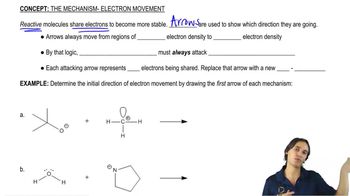
Learning the rules of electron movement

Nucleophiles and Electrophiles

Nucleophiles are species that donate electron pairs, while electrophiles are electron-deficient species that accept electron pairs. Identifying these roles in a reaction is essential for understanding how reactants interact and transform into products. This concept is foundational for analyzing reaction mechanisms.
Video consigliato:
03:
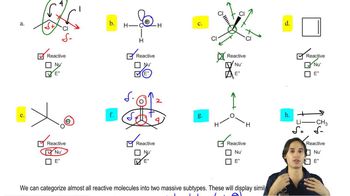
Nucleophile or Electrophile

Reaction Mechanisms

A reaction mechanism describes the step-by-step process by which reactants convert into products, including the breaking and forming of bonds. It provides insight into the intermediates and transition states involved in the reaction. Understanding mechanisms is vital for predicting reaction outcomes and designing new synthetic pathways.
Video consigliato:
02:16
Heck Reaction Mechanism