Ch. 28 - Pericyclic Reactions
Bruice - Organic Chemistry 8th Edition
Bruice8th EditionOrganic ChemistryISBN: 9780135213711Non è quello che usi tu?Cambia libro di testo
Capitolo 24, Problema 43

Explain why compound A will not undergo a ring-opening reaction under thermal conditions, but compound B will.

Guida verificata passo dopo passo
1
Analyze the structures of compound A and compound B. Compound A is a bicyclic system with a six-membered ring fused to a three-membered ring, while compound B is a bicyclic system with an eight-membered ring fused to a three-membered ring.
Consider the strain in the three-membered ring. Both compounds have a cyclopropane ring, which is highly strained due to its small bond angles (approximately 60° compared to the ideal tetrahedral angle of 109.5°). This strain makes cyclopropane rings susceptible to ring-opening reactions.
Evaluate the strain in the larger rings. Compound A has a six-membered ring, which is relatively stable due to its ability to adopt a chair conformation, minimizing angle and torsional strain. Compound B has an eight-membered ring, which is less stable due to increased angle strain and torsional strain, making it more reactive under thermal conditions.
Consider the thermal conditions. Under heat, ring-opening reactions are more likely to occur if the reaction leads to a decrease in overall strain. For compound A, opening the cyclopropane ring would not significantly reduce strain because the six-membered ring is already stable. For compound B, opening the cyclopropane ring would relieve strain in both the cyclopropane and the eight-membered ring, making the reaction thermodynamically favorable.
Conclude that compound A will not undergo a ring-opening reaction under thermal conditions because the strain relief is minimal, while compound B will undergo the reaction because it leads to significant strain relief in the eight-membered ring.

Risposta video verificata per un problema simile:

Questa soluzione video è stata consigliata dai nostri tutor come utile per risolvere questo problema.
Durata del video:
8m

Concetti chiave

Ecco i concetti essenziali che devi comprendere per rispondere correttamente alla domanda.

Thermal Stability of Cyclic Compounds

The thermal stability of cyclic compounds is influenced by their ring strain and the nature of the substituents. Compounds with lower ring strain, such as those with six-membered rings, are generally more stable and less likely to undergo ring-opening reactions under thermal conditions. In contrast, compounds with higher ring strain, like three- or four-membered rings, are more reactive and can easily open up when heated.
Video consigliato:
06:36
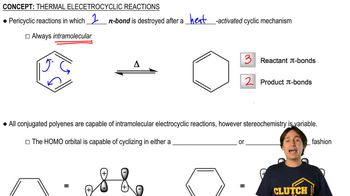
MO Theory of Thermal Electrocyclics

Mechanism of Ring-Opening Reactions

Ring-opening reactions typically involve the breaking of a sigma bond in the ring structure, which can be facilitated by heat or the presence of nucleophiles. The mechanism often depends on the stability of the transition state and the energy required to break the bonds. Compounds that can stabilize the transition state or have favorable sterics or electronics are more likely to undergo these reactions.
Video consigliato:
04:34
Acid-Catalyzed Epoxide Ring-Opening

Substituent Effects on Reactivity

The presence and nature of substituents on a cyclic compound can significantly affect its reactivity. Electron-withdrawing groups can stabilize positive charges in transition states, while electron-donating groups can destabilize them. This means that compounds with certain substituents may be more prone to ring-opening under thermal conditions, while others may remain stable due to the electronic effects of their substituents.
Video consigliato:
Percorso guidato
3:26
Directing Effects in Substituted Pyrroles, Furans, and Thiophenes Concept 2