a. Will thermal 1,3-migrations of carbon occur with retention or inversion of configuration?
Ch. 28 - Pericyclic Reactions
Capitolo 24, Problema 20
Explain why the hydrogen and the methyl substituent are trans to one another after photochemical ring closure of provitamin D3 to form 7-dehydrocholesterol.
Guida verificata passo dopo passo1
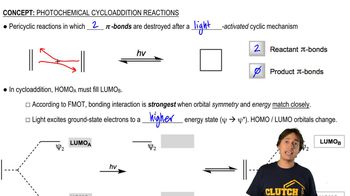
Understand the context: The photochemical ring closure of provitamin D3 involves a [2+2] cycloaddition reaction, which is a pericyclic reaction. This reaction occurs under UV light and forms a cyclobutane ring. The stereochemistry of the product is determined by the orbital interactions during the reaction.
Recognize the key stereochemical principle: In a [2+2] cycloaddition, the reaction proceeds through the interaction of the π orbitals of the double bonds. The stereochemistry of the substituents in the product is governed by the relative orientation of the reacting π orbitals in the excited state.
Analyze the geometry of the starting material: In provitamin D3, the double bonds involved in the reaction are part of a conjugated triene system. Upon UV irradiation, one of the double bonds is excited to a higher energy state, and the reaction occurs between the excited double bond and the adjacent double bond. The substituents on the reacting carbons are positioned in a way that minimizes steric hindrance and maximizes orbital overlap.
Explain the trans relationship: During the photochemical reaction, the hydrogen and methyl substituents on the reacting carbons are positioned on opposite sides of the forming cyclobutane ring. This trans arrangement is a result of the anti-periplanar alignment of the substituents in the transition state, which minimizes steric clashes and ensures efficient orbital overlap.
Conclude with the product's stereochemistry: The final product, 7-dehydrocholesterol, retains the trans relationship between the hydrogen and methyl substituents because the reaction is stereospecific. The stereochemistry is locked in during the ring closure and reflects the geometry of the transition state.

Risposta video verificata per un problema simile:
Questa soluzione video è stata consigliata dai nostri tutor come utile per risolvere questo problema.
Durata del video:
3mConcetti chiave
Ecco i concetti essenziali che devi comprendere per rispondere correttamente alla domanda.
Photochemical Reactions
Photochemical reactions involve the absorption of light to initiate a chemical change. In the context of organic chemistry, these reactions can lead to the formation of new bonds and rearrangements of molecular structures. Understanding the principles of photochemistry is essential for analyzing how light can influence the spatial arrangement of atoms in a molecule, such as during the ring closure of provitamin D3.
Video consigliato:
MO Theory of Photochemical Cycloadditions
Stereochemistry
Stereochemistry is the study of the spatial arrangement of atoms in molecules and how this affects their chemical behavior. In the case of 7-dehydrocholesterol formation, the trans configuration of hydrogen and methyl substituents is a result of the specific stereochemical pathways taken during the reaction. Recognizing the importance of stereochemistry helps explain why certain substituents adopt specific orientations in the final product.
Video consigliato:
Percorso guidato
Polymer Stereochemistry Concept 1
Ring Closure Mechanisms
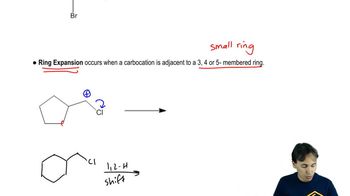
Ring closure mechanisms refer to the processes by which linear or open-chain molecules form cyclic structures. In the case of provitamin D3, the photochemical ring closure leads to the formation of a cyclic compound, 7-dehydrocholesterol. The mechanism of this closure, including the orientation of substituents, is crucial for understanding the resulting molecular geometry and the implications for biological activity.
Video consigliato:
Ring Expansion
Pratica correlata
Domanda del libro di testo
154
views
Domanda del libro di testo
b. Will thermal 1,5-migrations of carbon occur with retention or inversion of configuration?
862
views
Domanda del libro di testo
Draw the product of each of the following reactions:
d.
1023
views
Domanda del libro di testo
Draw the product of each of the following reactions:
e.
927
views
Domanda del libro di testo
Chorismate mutase is an enzyme that promotes a pericyclic reaction by forcing the substrate to assume the conformation needed for the reaction. The product of the pericyclic reaction is prephenate that is subsequently converted into the amino acids phenylalanine and tyrosine. What kind of a pericyclic reaction does chorismate mutase catalyze?
922
views
Domanda del libro di testo
Does the [1,7] sigmatropic rearrangement that converts provitamin D3 to vitamin D3 involve suprafacial or antarafacial rearrangement?
70
views