Ch. 28 - Pericyclic Reactions
Bruice - Organic Chemistry 8th Edition
Bruice8th EditionOrganic ChemistryISBN: 9780135213711Non è quello che usi tu?Cambia libro di testo
Capitolo 24, Problema 27

Show how the reactant can be converted to the product in two steps.
Chemical reaction diagram showing conversion of a reactant with an OH group to a product with a carbonyl group in two steps.

Guida verificata passo dopo passo
1
Step 1: Analyze the reactant and product structures. The reactant contains an alcohol (-OH) group attached to a cyclohexane ring with a conjugated diene system. The product has a ketone (C=O) group in place of the alcohol, indicating oxidation. Additionally, the conjugated diene system remains intact.
Step 2: Perform the first reaction to oxidize the alcohol to a ketone. Use an oxidizing agent such as PCC (Pyridinium Chlorochromate) or DMP (Dess-Martin Periodinane) to selectively oxidize the secondary alcohol to a ketone without affecting the double bonds.
Step 3: Verify that the ketone is formed after the first step. The structure should now have a ketone group replacing the alcohol group, while the conjugated diene system remains unchanged.
Step 4: Ensure no further modifications are needed to the conjugated diene system, as it is already present in the product structure. The second step involves confirming the stability of the product.
Step 5: Review the reaction conditions to ensure the product matches the desired structure. The two-step process involves selective oxidation and preservation of the conjugated diene system.

Risposta video verificata per un problema simile:

Questa soluzione video è stata consigliata dai nostri tutor come utile per risolvere questo problema.
Durata del video:
6m

Concetti chiave

Ecco i concetti essenziali che devi comprendere per rispondere correttamente alla domanda.

Reaction Mechanism

A reaction mechanism is a step-by-step description of how reactants are converted into products in a chemical reaction. It outlines the individual steps, including bond breaking and formation, and the intermediates formed along the way. Understanding the mechanism is crucial for predicting the outcome of reactions and for designing synthetic pathways.
Video consigliato:
02:16
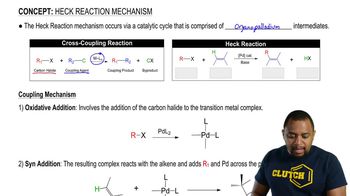
Heck Reaction Mechanism

Functional Groups

Functional groups are specific groups of atoms within molecules that are responsible for the characteristic chemical reactions of those molecules. Identifying functional groups in the reactant and product is essential for understanding how to manipulate the structure during the conversion process. They dictate the reactivity and properties of organic compounds.
Video consigliato:
02:36
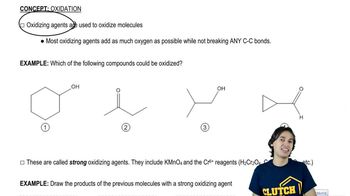
Identifying Functional Groups

Reagents and Conditions

Reagents are substances used to bring about a chemical reaction, while conditions refer to the environment in which the reaction occurs, such as temperature, pressure, and solvent. Knowing the appropriate reagents and conditions is vital for successfully converting a reactant to a product, as they influence the reaction pathway and efficiency.
Video consigliato:
01:52
Reagents