Ch. 3 - An Introduction to Organic Compounds: Nomenclature, Physical Properties, and Structure
Bruice - Organic Chemistry 8th Edition
Bruice8th EditionOrganic ChemistryISBN: 9780135213711Non è quello che usi tu?Cambia libro di testo
Capitolo 3, Problema 22a(6)

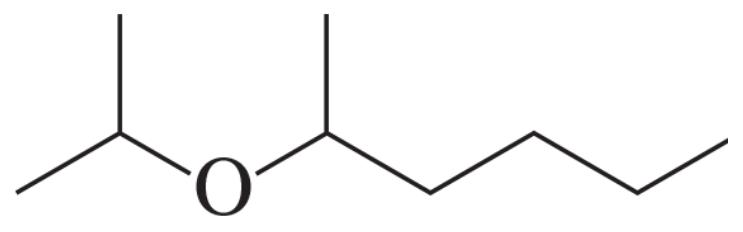
What is each ether's systematic name?
6.

Guida verificata passo dopo passo
1
Step 1: Identify the ether functional group in the molecule. An ether consists of an oxygen atom bonded to two alkyl or aryl groups. In this structure, the oxygen atom is connected to two carbon chains.
Step 2: Determine the longest continuous carbon chain on each side of the oxygen atom. On the left side, there is a chain of 4 carbons (butyl group). On the right side, there is a chain of 3 carbons with a methyl group attached to the second carbon (isopropyl group).
Step 3: Name each alkyl group attached to the oxygen atom. The left chain is named 'butyl,' and the right chain is named 'isopropyl.'
Step 4: Combine the names of the alkyl groups in alphabetical order followed by the word 'ether.' Since 'butyl' comes after 'isopropyl' alphabetically, the name will be 'isopropyl butyl ether.'
Step 5: Verify the systematic name by ensuring that the naming follows IUPAC conventions and accurately describes the structure of the molecule.

Risposta video verificata per un problema simile:

Questa soluzione video è stata consigliata dai nostri tutor come utile per risolvere questo problema.
Durata del video:
5m

Concetti chiave

Ecco i concetti essenziali che devi comprendere per rispondere correttamente alla domanda.

Ethers

Ethers are organic compounds characterized by an oxygen atom bonded to two alkyl or aryl groups. They have the general formula R-O-R', where R and R' represent hydrocarbon chains. Ethers are commonly used as solvents and in the synthesis of other organic compounds due to their relatively low reactivity.
Video consigliato:
04:22
How to predict the products of Ether Cleavage.

Systematic Naming

Systematic naming in organic chemistry follows the IUPAC (International Union of Pure and Applied Chemistry) rules, which provide a standardized method for naming compounds. This involves identifying the longest carbon chain, determining the functional groups, and assigning locants to indicate the position of substituents. For ethers, the names are derived from the alkyl groups attached to the oxygen, often using the suffix '-ether'.
Video consigliato:
03:43
The different parts of an IUPAC name

Functional Groups

Functional groups are specific groups of atoms within molecules that are responsible for the characteristic chemical reactions of those molecules. In the case of ethers, the functional group is the ether group (-O-), which influences the compound's properties and reactivity. Understanding functional groups is essential for predicting the behavior of organic compounds in chemical reactions.
Video consigliato:
02:36
Identifying Functional Groups