
Ch. 3 - An Introduction to Organic Compounds: Nomenclature, Physical Properties, and Structure
Bruice - Organic Chemistry 8th Edition
Bruice8th EditionOrganic ChemistryISBN: 9780135213711Non è quello che usi tu?Cambia libro di testo
Capitolo 3, Problema 72b

Draw all the isomers that have molecular formula C5H11Br. (Hint: There are eight.)
b. Give a common name for each isomer that has a common name.

Guida verificata passo dopo passo
1
Step 1: Understand the problem. The molecular formula C5H11Br indicates a brominated alkane with five carbon atoms. Isomers are compounds with the same molecular formula but different structural arrangements. We need to draw all possible structural isomers and name them appropriately.
Step 2: Begin by considering the straight-chain structure (n-pentane). Replace one hydrogen atom with a bromine atom at different positions along the chain to create isomers. For example, bromine can be attached to the first, second, or third carbon atom in the chain.
Step 3: Next, consider branched-chain structures. Create isomers by branching the carbon chain (e.g., isobutane or neopentane skeletons). Replace one hydrogen atom with bromine at different positions in these branched structures.
Step 4: For each structure, ensure that you are not duplicating isomers. Check for symmetry in the molecule to avoid counting the same isomer twice. For example, bromine on the first carbon of n-pentane is equivalent to bromine on the fifth carbon due to symmetry.
Step 5: Assign common names to each isomer where applicable. Common names are based on the alkyl group attached to bromine (e.g., n-butyl bromide, isobutyl bromide, etc.). Use IUPAC naming conventions for any isomers that do not have widely recognized common names.

Risposta video verificata per un problema simile:

Questa soluzione video è stata consigliata dai nostri tutor come utile per risolvere questo problema.
Durata del video:
3m

Concetti chiave

Ecco i concetti essenziali che devi comprendere per rispondere correttamente alla domanda.

Isomerism

Isomerism refers to the phenomenon where compounds with the same molecular formula exhibit different structural or spatial arrangements. In organic chemistry, isomers can be classified into structural isomers, which differ in the connectivity of atoms, and stereoisomers, which differ in the orientation of atoms in space. Understanding isomerism is crucial for identifying and drawing all possible isomers for a given molecular formula.
Video consigliato:
06:47
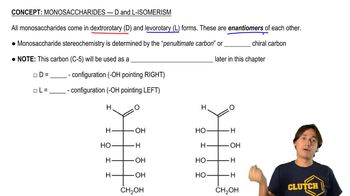
Monosaccharides - D and L Isomerism

Branched vs. Straight-Chain Alkanes

Branched and straight-chain alkanes are types of hydrocarbons that differ in their structure. Straight-chain alkanes have a continuous chain of carbon atoms, while branched alkanes contain one or more branches off the main chain. Recognizing these differences is essential for drawing isomers, as the branching can lead to multiple structural variations for the same molecular formula.
Video consigliato:
02:47
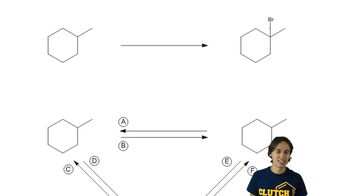
Functionalizing Alkanes

Common Names of Organic Compounds

Common names are informal names used to identify organic compounds, often based on historical or traditional naming conventions rather than systematic IUPAC rules. For example, isomers of C5H11Br may include common names like 'pentyl bromide' or 'isobutyl bromide.' Familiarity with these common names helps in quickly identifying and communicating about specific isomers in organic chemistry.
Video consigliato:
02:43
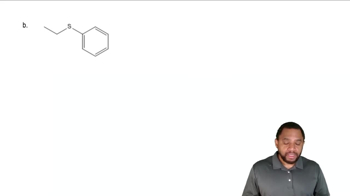
Provide the IUPAC name and common name for the following compound.