
Ch. 4 - Isomers: The Arrangement of Atoms in Space
Bruice - Organic Chemistry 8th Edition
Bruice8th EditionOrganic ChemistryISBN: 9780135213711Non è quello che usi tu?Cambia libro di testo
Capitolo 4, Problema 102b

For each pair, indicate which conformer is more stable.

Guida verificata passo dopo passo
1
Step 1: Analyze the chair conformations for both pairs (i) and (ii). In chair conformations, substituents can occupy axial (vertical) or equatorial (angled) positions. Equatorial positions are generally more stable due to reduced steric hindrance.
Step 2: For pair (i), observe the positions of the substituents in Conformer A and Conformer B. In Conformer A, the CH₃ group is equatorial, and the bulky CH(CH₃)₂ group is axial. In Conformer B, the CH₃ group is axial, and the bulky CH(CH₃)₂ group is equatorial. Bulky groups prefer equatorial positions to minimize steric hindrance.
Step 3: For pair (ii), observe the positions of the substituents in Conformer A and Conformer B. In Conformer A, the bulky CH(CH₃)₂ group is equatorial, and the CH₃ group is axial. In Conformer B, the CH₃ group is equatorial, and the bulky CH(CH₃)₂ group is axial. Again, bulky groups prefer equatorial positions to minimize steric hindrance.
Step 4: Compare the stability of the conformers in each pair based on steric hindrance. The conformer with the bulky group in the equatorial position will be more stable.
Step 5: Conclude that for pair (i), Conformer B is more stable because the bulky CH(CH₃)₂ group is equatorial. For pair (ii), Conformer A is more stable because the bulky CH(CH₃)₂ group is equatorial.

Risposta video verificata per un problema simile:

Questa soluzione video è stata consigliata dai nostri tutor come utile per risolvere questo problema.
Durata del video:
2m

Concetti chiave

Ecco i concetti essenziali che devi comprendere per rispondere correttamente alla domanda.

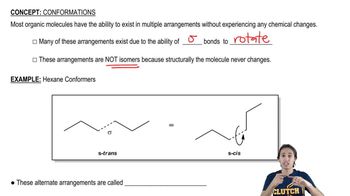
Conformational Analysis

Conformational analysis involves studying the different spatial arrangements of atoms in a molecule that can be interconverted by rotation around single bonds. In alkanes, these conformers can adopt various shapes, affecting their stability due to steric interactions and torsional strain. Understanding these conformations is crucial for predicting the most stable form of a molecule.
Video consigliato:
03:29
Understanding what a conformer is.

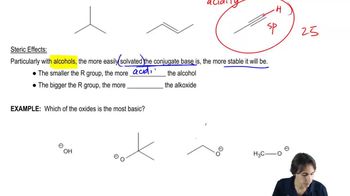
Steric Hindrance

Steric hindrance refers to the repulsion between bulky groups within a molecule that can lead to increased energy and decreased stability. In conformers, steric hindrance can arise when larger substituents are positioned close to each other, causing strain. Identifying which conformer minimizes steric hindrance is essential for determining stability.
Video consigliato:
02:53
Understanding steric effects.

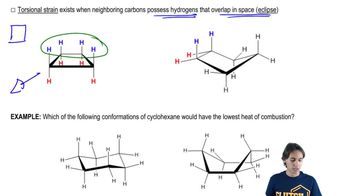
Torsional Strain

Torsional strain occurs when atoms in a molecule are eclipsed or partially eclipsed, leading to increased energy due to repulsion between electron clouds. In conformers, this strain is particularly relevant when analyzing staggered versus eclipsed arrangements. A conformer that minimizes torsional strain is generally more stable, making it a key factor in conformational stability.
Video consigliato:
02:00
What is torsional strain?