Ch. 5 - Alkenes: Structure, Nomenclature, and an Introduction to Reactivity • Thermodynamics and Kinetics
Bruice - Organic Chemistry 8th Edition
Bruice8th EditionOrganic ChemistryISBN: 9780135213711Non è quello che usi tu?Cambia libro di testo
Capitolo 5, Problema 44

a. Draw the condensed structures and give the systematic names for all the alkenes with molecular formula C6H12, ignoring stereoisomers. (Hint: There are 13.)
b. Which of the alkenes have E and Z isomers?
c. Which of the alkenes is the most stable?
d. Which of the alkenes is the least stable?

Guida verificata passo dopo passo
1
Step 1: Begin by understanding the molecular formula C6H12. This formula corresponds to alkenes, which are hydrocarbons containing at least one double bond. The general formula for alkenes is CnH2n, indicating one degree of unsaturation (a double bond).
Step 2: To draw the condensed structures, systematically consider all possible carbon chain arrangements (straight chains and branched chains) with six carbons. Place the double bond in different positions along the chain to generate unique structures. Ensure you account for all possible structural isomers, ignoring stereoisomers for now.
Step 3: Assign systematic names to each structure using IUPAC nomenclature rules. Identify the longest carbon chain containing the double bond, number the chain to give the double bond the lowest possible number, and name substituents accordingly. Verify that you have 13 unique structures.
Step 4: To determine which alkenes have E/Z isomers, identify structures with a double bond where two different groups are attached to each carbon of the double bond. Use the Cahn-Ingold-Prelog priority rules to distinguish E (opposite sides) and Z (same side) configurations.
Step 5: Evaluate the stability of the alkenes. Stability is influenced by factors such as the degree of substitution of the double bond (more substituted alkenes are more stable) and steric hindrance. The least stable alkene will likely be the one with the least substitution and/or the most steric strain.

Risposta video verificata per un problema simile:

Questa soluzione video è stata consigliata dai nostri tutor come utile per risolvere questo problema.
Durata del video:
16m

Concetti chiave

Ecco i concetti essenziali che devi comprendere per rispondere correttamente alla domanda.

Alkene Structure and Nomenclature

Alkenes are hydrocarbons that contain at least one carbon-carbon double bond (C=C). The molecular formula C6H12 indicates that the compound is an alkene, as it follows the general formula CnH2n for alkenes. Systematic naming involves identifying the longest carbon chain containing the double bond and using the appropriate suffix, typically '-ene', along with locants to indicate the position of the double bond.
Video consigliato:
Percorso guidato
4:02
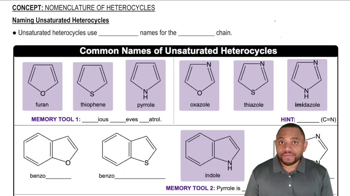
Nomenclature of Heterocycles Concept 2

E/Z Isomerism

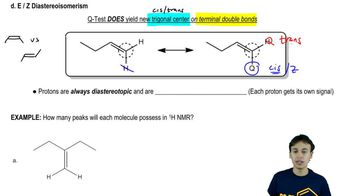
E/Z isomerism is a type of stereoisomerism that occurs in alkenes due to the restricted rotation around the double bond. The 'E' (entgegen) configuration indicates that the highest priority substituents on each carbon of the double bond are on opposite sides, while 'Z' (zusammen) indicates they are on the same side. To determine E/Z configurations, the Cahn-Ingold-Prelog priority rules are applied to the substituents attached to the double-bonded carbons.
Video consigliato:
03:48
E/Z Diastereoisomerism

Stability of Alkenes

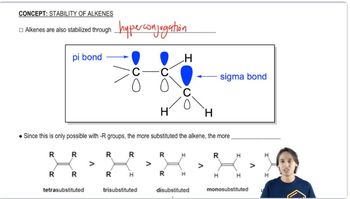
The stability of alkenes is influenced by factors such as substitution and steric strain. Generally, more substituted alkenes (those with more alkyl groups attached to the double bond) are more stable due to hyperconjugation and the inductive effect. Conversely, less substituted alkenes are less stable. The stability can also be affected by steric hindrance and the presence of strain in cyclic alkenes.
Video consigliato:
04:28
Understanding trends of alkene stability.