Ch. 5 - Alkenes: Structure, Nomenclature, and an Introduction to Reactivity • Thermodynamics and Kinetics
Bruice - Organic Chemistry 8th Edition
Bruice8th EditionOrganic ChemistryISBN: 9780135213711Non è quello che usi tu?Cambia libro di testo
Capitolo 5, Problema 61

a. What is the equilibrium constant for a reaction that is carried out at 25 °C (298 K) with ∆H° = 20 kcal/mol and ∆S° = 5.0 × 10⁻² kcal mol-1 K-1?
b. What is the equilibrium constant for the same reaction carried out at 125 °C?

Guida verificata passo dopo passo
1
Step 1: Recall the relationship between the Gibbs free energy change (ΔG°) and the equilibrium constant (K). The equation is ΔG° = -RT ln(K), where R is the gas constant (1.987 cal mol⁻¹ K⁻¹), T is the temperature in Kelvin, and K is the equilibrium constant.
Step 2: Use the thermodynamic relationship ΔG° = ΔH° - TΔS° to calculate ΔG° at each temperature. For part (a), substitute ΔH° = 20 kcal/mol, ΔS° = 5.0 × 10⁻² kcal mol⁻¹ K⁻¹, and T = 298 K into the equation. For part (b), use T = 125 °C, which must first be converted to Kelvin (T = 125 + 273 = 398 K).
Step 3: Convert ΔH° and ΔS° into consistent units if necessary. Since R is given in cal mol⁻¹ K⁻¹, convert ΔH° and ΔS° from kcal to cal by multiplying by 1000 (1 kcal = 1000 cal). This ensures all units are consistent for calculations.
Step 4: Calculate ΔG° for each temperature using the equation ΔG° = ΔH° - TΔS°. Substitute the values for ΔH°, T, and ΔS° into the equation for both temperatures (298 K and 398 K).
Step 5: Rearrange the equation ΔG° = -RT ln(K) to solve for K. Use the calculated ΔG° values for each temperature and substitute them into the equation ln(K) = -ΔG° / (RT). Finally, exponentiate both sides to solve for K: K = e^(-ΔG° / (RT)).

Risposta video verificata per un problema simile:

Questa soluzione video è stata consigliata dai nostri tutor come utile per risolvere questo problema.
Durata del video:
4m

Concetti chiave

Ecco i concetti essenziali che devi comprendere per rispondere correttamente alla domanda.

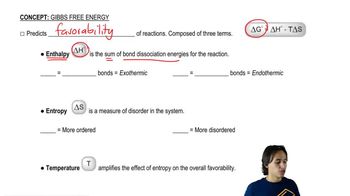
Gibbs Free Energy

Gibbs Free Energy (G) is a thermodynamic potential that measures the maximum reversible work obtainable from a thermodynamic system at constant temperature and pressure. The change in Gibbs Free Energy (∆G) is related to the equilibrium constant (K) of a reaction through the equation ∆G = -RT ln(K), where R is the universal gas constant and T is the temperature in Kelvin. A negative ∆G indicates a spontaneous reaction, while a positive ∆G suggests non-spontaneity.
Video consigliato:
05:02
Breaking down the different terms of the Gibbs Free Energy equation.

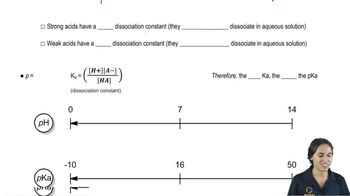
Equilibrium Constant (K)

The equilibrium constant (K) is a dimensionless value that expresses the ratio of the concentrations of products to reactants at equilibrium for a given reaction at a specific temperature. It is derived from the standard Gibbs Free Energy change (∆G°) of the reaction, and it can be calculated using the equation K = e^(-∆G°/RT). The value of K provides insight into the position of equilibrium, indicating whether products or reactants are favored.
Video consigliato:
02:19
The relationship between equilibrium constant and pKa.

Van 't Hoff Equation

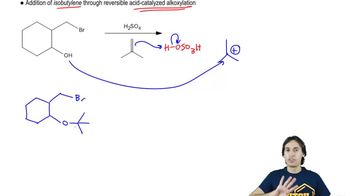
The Van 't Hoff equation relates the change in the equilibrium constant (K) of a reaction to the change in temperature (T) and the enthalpy change (∆H°) of the reaction. It is expressed as ln(K2/K1) = -∆H°/R(1/T2 - 1/T1). This equation allows for the calculation of the equilibrium constant at different temperatures, providing a way to understand how temperature influences the position of equilibrium in a chemical reaction.
Video consigliato:
05:49
Mechanism of t-Butyl Ether Protecting Groups.
Pratica correlata
Domanda del libro di testo

a. Which of the following reactions has the larger ∆S° value?

b. Is the ∆S° value positive or negative?

1095
views

Domanda del libro di testo

Draw the structure of a compound with molecular C8H14 that reacts with one equivalent of H2 over Pd/C to form a meso compound

1911
views
Domanda del libro di testo

Given the reaction coordinate diagram for the reaction of A to form G, answer the following questions:

<IMAGE>

a. How many intermediates are formed in the reaction?

b. Which letters represent transition states?

c. What is the fastest step in the reaction?

d. Which is more stable: A or G?

e. Does A or E form faster from C?

f. Which is the more stable intermediate?

2038
views
Domanda del libro di testo

Given that the free energy of the twist-boat conformer of cyclohexane is 5.3 kcal/mol greater than that of the chair conformer, calculate the percentage of twist-boat conformers present in a sample of cyclohexane at 25 °C. Does your answer agree with the statement made in Section 3.13 about the relative number of molecules in these two conformations?

936
views
Domanda del libro di testo

For a reaction carried out at 25 °C with an equilibrium constant of 1 × 10⁻³, to increase the equilibrium constant by a factor of 10:

a. how much must ∆G° change?

b. how much must ∆H° change if ∆S° = 0 kcal mol-1 K-1?

c. how much must ∆S° change if ∆H° = 0 kcal mol-1?

863
views
Domanda del libro di testo

Using curved arrows, show the mechanism of the following reaction:

3467
views