Ch. 5 - Alkenes: Structure, Nomenclature, and an Introduction to Reactivity • Thermodynamics and Kinetics
Bruice - Organic Chemistry 8th Edition
Bruice8th EditionOrganic ChemistryISBN: 9780135213711Non è quello che usi tu?Cambia libro di testo
Capitolo 5, Problema 37a-d

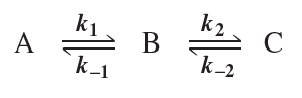
Draw a reaction coordinate diagram for the following reaction in which C is the most stable and B the least stable of the three species and the transition state going from A to B is more stable than the transition state going from B to C:
Reaction coordinate diagram showing species A, B, and C with transition states and rate constants labeled.
a. How many intermediates are there?
b. How many transition states are there?
c. Which step has the greater rate constant in the forward direction?
d. Which step has the greater rate constant in the reverse direction?

Guida verificata passo dopo passo
1
Step 1: Analyze the reaction coordinate diagram requirements. The reaction involves three species (A, B, and C), where C is the most stable and B is the least stable. This means the energy of C is the lowest, and the energy of B is the highest. A is intermediate in stability.
Step 2: Identify the transition states. Transition states occur at the peaks of the energy barriers between species. Since there are two steps in the reaction (A to B and B to C), there will be two transition states. The transition state going from A to B is more stable (lower energy) than the transition state going from B to C.
Step 3: Determine the number of intermediates. Intermediates are species that exist in valleys between transition states. In this reaction, B is the intermediate because it is formed after A and before C.
Step 4: Compare the rate constants in the forward direction. The rate constant for the forward direction depends on the height of the energy barrier. Since the transition state from A to B is more stable (lower energy barrier), the rate constant for the step A to B (k1) will be greater than the rate constant for the step B to C (k2).
Step 5: Compare the rate constants in the reverse direction. The reverse rate constant depends on the energy barrier for the reverse reaction. Since B is the least stable species, the reverse rate constant for the step B to A (k-1) will be greater than the reverse rate constant for the step C to B (k-2).

Risposta video verificata per un problema simile:

Questa soluzione video è stata consigliata dai nostri tutor come utile per risolvere questo problema.
Durata del video:
8m

Concetti chiave

Ecco i concetti essenziali che devi comprendere per rispondere correttamente alla domanda.

Reaction Coordinate Diagram

A reaction coordinate diagram visually represents the energy changes during a chemical reaction. It plots the energy of the reactants, products, and transition states against the progress of the reaction. The diagram helps identify intermediates and transition states, illustrating the stability of each species and the energy barriers that must be overcome for the reaction to proceed.
Video consigliato:
05:02
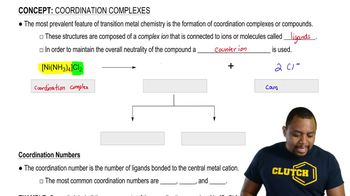
Coordination Complexes

Transition States and Intermediates

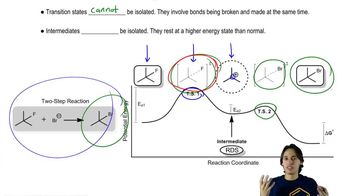
Transition states are high-energy states that occur during the transformation from reactants to products, representing the point of maximum energy along the reaction pathway. Intermediates, on the other hand, are species that exist at a lower energy than the transition states and are formed during the reaction but are not the final products. Understanding the distinction between these two concepts is crucial for analyzing reaction mechanisms.
Video consigliato:
06:55
Intermediates vs. Transition States

Rate Constants and Reaction Rates

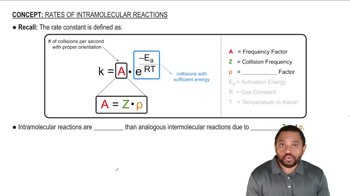
Rate constants (k) quantify the speed of a reaction and are influenced by the energy barriers associated with the transition states. A higher rate constant indicates a faster reaction. In the context of the given question, comparing the rate constants for the forward and reverse reactions helps determine which step is more favorable and provides insight into the overall kinetics of the reaction.
Video consigliato:
Percorso guidato
2:29
Rates of Intramolecular Reactions Concept 1
Pratica correlata
Domanda del libro di testo

What is each compound's systematic name?

b.

1206
views

Domanda del libro di testo

What is each compound's systematic name?

a.

1271
views
Domanda del libro di testo

Draw a reaction coordinate diagram for a two-step reaction in which the first step is endergonic, the second step is exergonic, and the overall reaction is endergonic. Label the reactants, products, intermediates, and transition states.

1517
views
Domanda del libro di testo

a. Which step in the reaction coordinate diagram shown here has the greatest free energy of activation in the forward direction?

b. Is the first-formed intermediate more apt to revert to reactants or go on to form products?

c. Which step is the rate-determining step of the reaction?

<IMAGE>

2091
views
2
rank
Domanda del libro di testo

Which of the following parameters would be different for a reaction carried out in the presence of a catalyst compared with the same reaction carried out in the absence of a catalyst?

∆G°, ∆H‡, Ea, ∆S‡, ∆H°, Keq, ∆G‡, ∆S°, k

1160
views
Domanda del libro di testo

a. Which reaction has a greater equilibrium constant: one with a rate constant of 1 × 10⁻³ sec-1 for the forward reaction and a rate constant of 1 × 10⁻⁵ sec-1 for the reverse reaction, or one with a rate constant of 1 × 10⁻² sec-1 for the forward reaction and a rate constant of 1 × 10⁻³ sec-1 for the reverse reaction?

b. If both reactions start with a reactant concentration of 1.0 M, which reaction will form the most product when the reactions have reached equilibrium?

1664
views