Ch. 5 - Alkenes: Structure, Nomenclature, and an Introduction to Reactivity • Thermodynamics and Kinetics
Bruice - Organic Chemistry 8th Edition
Bruice8th EditionOrganic ChemistryISBN: 9780135213711Non è quello che usi tu?Cambia libro di testo
Capitolo 5, Problema 33a

From the Arrhenius equation, predict how
a. increasing the experimental activation energy affects the rate constant for a reaction.

Guida verificata passo dopo passo
1
Understand the Arrhenius equation: The Arrhenius equation is given by \( k = A e^{-\frac{E_a}{RT}} \), where \( k \) is the rate constant, \( A \) is the pre-exponential factor, \( E_a \) is the activation energy, \( R \) is the gas constant, and \( T \) is the temperature in Kelvin.
Identify the role of activation energy (\( E_a \)) in the equation: Activation energy is the minimum energy required for a reaction to occur. It is represented in the exponent of the exponential term in the Arrhenius equation.
Analyze the effect of increasing \( E_a \): As the activation energy \( E_a \) increases, the value of the exponent \( -\frac{E_a}{RT} \) becomes more negative.
Consider the exponential function's behavior: The exponential function \( e^x \) decreases as \( x \) becomes more negative. Therefore, increasing \( E_a \) leads to a decrease in the value of \( e^{-\frac{E_a}{RT}} \).
Conclude the effect on the rate constant \( k \): Since the exponential term decreases with an increase in \( E_a \), the overall rate constant \( k \) also decreases. This means that the reaction will proceed at a slower rate.

Risposta video verificata per un problema simile:

Questa soluzione video è stata consigliata dai nostri tutor come utile per risolvere questo problema.
Durata del video:
2m

Concetti chiave

Ecco i concetti essenziali che devi comprendere per rispondere correttamente alla domanda.

Arrhenius Equation

The Arrhenius equation describes the temperature dependence of reaction rates, expressed as k = A * e^(-Ea/RT), where k is the rate constant, A is the pre-exponential factor, Ea is the activation energy, R is the universal gas constant, and T is the temperature in Kelvin. This equation illustrates how the rate constant changes with temperature and activation energy, providing insight into the kinetics of chemical reactions.
Video consigliato:
05:02
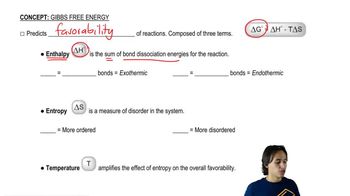
Breaking down the different terms of the Gibbs Free Energy equation.

Activation Energy (Ea)

Activation energy is the minimum energy required for a chemical reaction to occur. It represents the energy barrier that reactants must overcome to form products. A higher activation energy means that fewer molecules have sufficient energy to react at a given temperature, leading to a slower reaction rate and a lower rate constant.
Video consigliato:
Percorso guidato
3:22
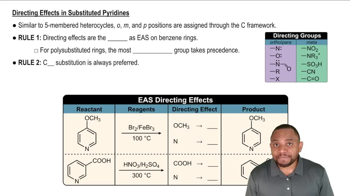
EAS Reactions of Pyridine Concept 3

Rate Constant (k)

The rate constant (k) is a proportionality factor in the rate law of a reaction, indicating the speed at which a reaction proceeds. It is influenced by factors such as temperature and activation energy. According to the Arrhenius equation, as the activation energy increases, the rate constant decreases, resulting in a slower reaction rate.
Video consigliato:
Percorso guidato
2:29
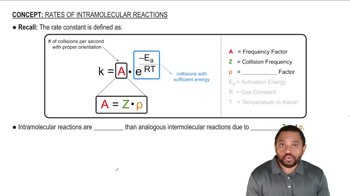
Rates of Intramolecular Reactions Concept 1
Pratica correlata
Domanda del libro di testo

Draw a reaction coordinate diagram for a reaction in which

a. the product is thermodynamically unstable and kinetically unstable.

b. the product is thermodynamically unstable and kinetically stable.

1443
views

Domanda del libro di testo

From the Arrhenius equation, predict how

b. increasing the temperature affects the rate constant for a reaction.

1119
views
Domanda del libro di testo

The rate constant for a reaction can be increased by ______ the stability of the reactant or by ______ the stability of the transition state.

1094
views
Domanda del libro di testo

Draw a reaction coordinate diagram for a two-step reaction in which the first step is endergonic, the second step is exergonic, and the overall reaction is endergonic. Label the reactants, products, intermediates, and transition states.

1517
views
Domanda del libro di testo

The rate of the reaction of methyl chloride with hydroxide ion is linearly dependent on both the concentration of methyl chloride and the concentration hydroxide ion. At 30 °C, the constant (k) for the reaction is 1.0 × 10⁻⁵ M-1 s-1

b. If the concentration of methyl chloride is decreased to 0.010 M, what will be the effect on

1. the rate of the reaction?

2. the rate constant for the reaction?

1503
views
Domanda del libro di testo

a. Which reaction has a greater equilibrium constant: one with a rate constant of 1 × 10⁻³ sec-1 for the forward reaction and a rate constant of 1 × 10⁻⁵ sec-1 for the reverse reaction, or one with a rate constant of 1 × 10⁻² sec-1 for the forward reaction and a rate constant of 1 × 10⁻³ sec-1 for the reverse reaction?

b. If both reactions start with a reactant concentration of 1.0 M, which reaction will form the most product when the reactions have reached equilibrium?

1664
views