Ch. 5 - Alkenes: Structure, Nomenclature, and an Introduction to Reactivity • Thermodynamics and Kinetics
Bruice - Organic Chemistry 8th Edition
Bruice8th EditionOrganic ChemistryISBN: 9780135213711Non è quello che usi tu?Cambia libro di testo
Capitolo 5, Problema 46a

Of the compounds you named in Problem 45:
a. Which is the most stable?
a.
b.
c.
d.
e.
f.

Guida verificata passo dopo passo
1
Step 1: Analyze the stability of each compound based on structural features such as branching, conjugation, and functional groups. Stability is often influenced by factors like hyperconjugation, resonance, and steric hindrance.
Step 2: For alkenes, evaluate the degree of substitution around the double bond. More substituted alkenes are generally more stable due to hyperconjugation and inductive effects.
Step 3: For compounds with functional groups like halogens or carbonyls, consider the electronic effects (e.g., inductive or resonance effects) that stabilize or destabilize the molecule.
Step 4: Compare the branching in alkyl chains. Highly branched alkanes are typically more stable due to reduced steric strain and increased van der Waals interactions.
Step 5: Rank the compounds based on the above factors to determine which is the most stable. Consider resonance stabilization, hyperconjugation, and steric effects collectively.

Risposta video verificata per un problema simile:

Questa soluzione video è stata consigliata dai nostri tutor come utile per risolvere questo problema.
Durata del video:
2m

Concetti chiave

Ecco i concetti essenziali che devi comprendere per rispondere correttamente alla domanda.

Stability of Organic Compounds

The stability of organic compounds is influenced by factors such as steric hindrance, electronic effects, and resonance. Compounds with lower steric strain and favorable electronic interactions tend to be more stable. Understanding these factors helps predict which compound will be the most stable among a set of options.
Video consigliato:
05:58
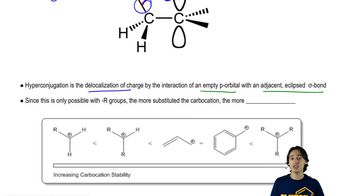
Determining Carbocation Stability

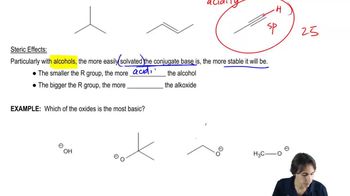
Steric Hindrance

Steric hindrance refers to the repulsion between bulky groups within a molecule, which can affect its stability and reactivity. Compounds with less steric hindrance are generally more stable, as they experience fewer spatial conflicts. Analyzing the molecular structure can reveal areas of steric strain that may impact stability.
Video consigliato:
02:53
Understanding steric effects.

Resonance Stabilization

Resonance stabilization occurs when a molecule can be represented by multiple valid Lewis structures, allowing for the delocalization of electrons. This delocalization can lower the overall energy of the molecule, enhancing its stability. Identifying resonance structures is crucial for determining the most stable compound in a given set.
Video consigliato:
03:43
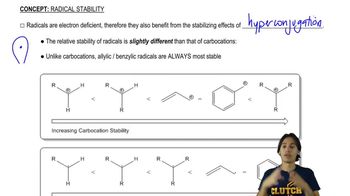
The radical stability trend.