Ch. 7 - The Reactions of Alkynes • An Introduction to Multistep Synthesis
Bruice - Organic Chemistry 8th Edition
Bruice8th EditionOrganic ChemistryISBN: 9780135213711Non è quello che usi tu?Cambia libro di testo
Capitolo 7, Problema 23

Any base whose conjugate acid has a pKa greater than ______ can remove a proton from a terminal alkyne to form an acetylide ion (in a reaction that favors products).

Guida verificata passo dopo passo
1
Understand the relationship between pKa and acidity: The pKa value of a conjugate acid is inversely related to its acidity. A higher pKa indicates a weaker acid, meaning its conjugate base is stronger.
Recall the acidity of terminal alkynes: Terminal alkynes have a relatively acidic hydrogen attached to the sp-hybridized carbon. The typical pKa of a terminal alkyne is approximately 25.
Identify the requirement for the base: To remove a proton from a terminal alkyne and form an acetylide ion, the base must be strong enough to deprotonate the alkyne. This means the conjugate acid of the base must have a pKa greater than the pKa of the terminal alkyne.
Set up the comparison: Since the pKa of a terminal alkyne is around 25, any base whose conjugate acid has a pKa greater than 25 can effectively remove the proton from the terminal alkyne.
Conclude the reasoning: Bases such as sodium amide (NaNH₂), whose conjugate acid (NH₃) has a pKa of approximately 38, are strong enough to deprotonate terminal alkynes and form acetylide ions in a reaction that favors the products.

Risposta video verificata per un problema simile:

Questa soluzione video è stata consigliata dai nostri tutor come utile per risolvere questo problema.
Durata del video:
3m

Concetti chiave

Ecco i concetti essenziali che devi comprendere per rispondere correttamente alla domanda.

pKa and Acid-Base Strength

pKa is a quantitative measure of the strength of an acid in solution; it is the negative logarithm of the acid dissociation constant (Ka). A lower pKa value indicates a stronger acid, which means it more readily donates protons. In the context of bases, a base can effectively deprotonate an acid if the pKa of the acid is higher than the pKa of the conjugate acid of the base.
Video consigliato:
07:45
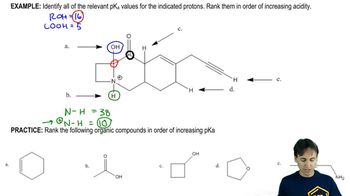
Identifying pKa values

Terminal Alkynes

Terminal alkynes are hydrocarbons that contain a triple bond between two carbon atoms, with one of the carbons at the end of the chain. They are unique in that the hydrogen atom attached to the terminal carbon can be removed by a strong base, resulting in the formation of an acetylide ion. This ion is a key intermediate in various organic reactions, including nucleophilic substitutions.
Video consigliato:
02:43
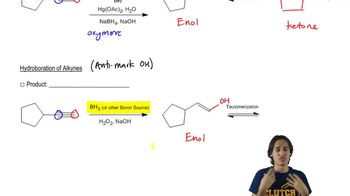
Anti-Markovnikov addition of alcohols to terminal alkynes yields aldehydes

Conjugate Acid-Base Pairs

In acid-base chemistry, a conjugate acid is formed when a base accepts a proton (H+), while a conjugate base is what remains after an acid donates a proton. Understanding the relationship between conjugate acids and bases is crucial for predicting the direction of acid-base reactions. The strength of a base is often assessed by the pKa of its conjugate acid, guiding whether it can effectively deprotonate a given acid.
Video consigliato:
Percorso guidato
2:56
Base Pairing Concept 1