Ch. 7 - The Reactions of Alkynes • An Introduction to Multistep Synthesis
Bruice - Organic Chemistry 8th Edition
Bruice8th EditionOrganic ChemistryISBN: 9780135213711Non è quello che usi tu?Cambia libro di testo
Capitolo 7, Problema 28d

How could the following compounds be synthesized from acetylene?
d.

Guida verificata passo dopo passo
1
Step 1: Begin with acetylene (C≡CH), a simple alkyne. The goal is to transform this molecule into the target compound, which is 2,2-dichloro-3,3-dimethylbutane.
Step 2: Perform a reaction to convert acetylene into a substituted alkyne. React acetylene with methyl iodide (CH3I) in the presence of a strong base like sodium amide (NaNH2). This will yield propyne (CH≡CCH3).
Step 3: Carry out a second alkylation reaction to further substitute the alkyne. React propyne with another equivalent of methyl iodide (CH3I) in the presence of NaNH2 to form 2-butyne (CH3C≡CCH3).
Step 4: Hydrogenate the alkyne to form the corresponding alkane. Use a Lindlar catalyst for partial hydrogenation to form 2-butene (CH3CH=CHCH3), or use a standard catalyst like Pd/C for complete hydrogenation to form butane (CH3CH2CH2CH3).
Step 5: Add chlorine atoms to the molecule. React the alkane or alkene with chlorine gas (Cl2) under UV light or appropriate conditions to form the desired compound, 2,2-dichloro-3,3-dimethylbutane. Ensure the reaction conditions favor substitution at the correct positions.

Risposta video verificata per un problema simile:

Questa soluzione video è stata consigliata dai nostri tutor come utile per risolvere questo problema.
Durata del video:
3m

Concetti chiave

Ecco i concetti essenziali che devi comprendere per rispondere correttamente alla domanda.

Acetylene Reactivity

Acetylene (C2H2) is a simple alkyne that can undergo various reactions due to its triple bond. It can participate in addition reactions, where reagents add across the triple bond, and can also be used in coupling reactions to form larger carbon frameworks. Understanding the reactivity of acetylene is crucial for determining how to synthesize more complex compounds from it.
Video consigliato:
01:17
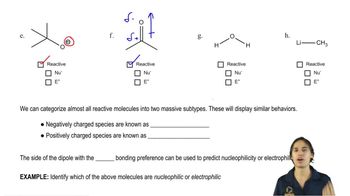
Reactivity of Molecules

Functional Group Transformations

Functional group transformations involve changing one functional group in a molecule to another, which is essential in organic synthesis. This concept is important when synthesizing compounds from acetylene, as it may require converting the alkyne into alcohols, aldehydes, or other functional groups through various reactions like hydroboration, oxidation, or halogenation.
Video consigliato:
02:36
Identifying Functional Groups

Synthetic Pathways

Synthetic pathways refer to the step-by-step methods used to construct a target molecule from simpler starting materials. In the context of synthesizing compounds from acetylene, it is important to outline a logical sequence of reactions that efficiently build the desired structure, taking into account the necessary reagents, conditions, and potential side reactions.
Video consigliato:
Percorso guidato
2:13
Energy Production In Biochemical Pathways Concept 1