Ch. 7 - The Reactions of Alkynes • An Introduction to Multistep Synthesis
Bruice - Organic Chemistry 8th Edition
Bruice8th EditionOrganic ChemistryISBN: 9780135213711Non è quello che usi tu?Cambia libro di testo
Capitolo 7, Problema 42

What is the molecular formula of a hydrocarbon that has 1 triple bond, 2 double bonds, 1 ring, and 32 carbons?

Guida verificata passo dopo passo
1
Step 1: Recall the general formula for a hydrocarbon. Hydrocarbons are composed of carbon (C) and hydrogen (H). The molecular formula depends on the degree of unsaturation, which includes double bonds, triple bonds, and rings.
Step 2: Use the degree of unsaturation formula to account for the structural features. The degree of unsaturation (DU) is calculated as: \( DU = \frac{2C + 2 - H}{2} \), where \( C \) is the number of carbons, and \( H \) is the number of hydrogens. Each double bond, triple bond, or ring contributes to the degree of unsaturation.
Step 3: For this problem, the hydrocarbon has 1 triple bond, 2 double bonds, and 1 ring. Each double bond contributes 1 degree of unsaturation, each triple bond contributes 2 degrees of unsaturation, and each ring contributes 1 degree of unsaturation. Add these contributions: \( 1 (triple bond) + 2 (double bonds) + 1 (ring) = 4 \).
Step 4: Use the degree of unsaturation to determine the number of hydrogens. For a hydrocarbon with 32 carbons (\( C = 32 \)) and a degree of unsaturation of 4, substitute into the formula: \( H = 2C + 2 - 2(DU) \). This simplifies to \( H = 2(32) + 2 - 2(4) \).
Step 5: Write the molecular formula. After determining the number of hydrogens (\( H \)), the molecular formula will be \( C_{32}H_x \), where \( x \) is the calculated number of hydrogens from Step 4.

Risposta video verificata per un problema simile:

Questa soluzione video è stata consigliata dai nostri tutor come utile per risolvere questo problema.
Durata del video:
3m

Concetti chiave

Ecco i concetti essenziali che devi comprendere per rispondere correttamente alla domanda.

Hydrocarbon Structure

Hydrocarbons are organic compounds consisting solely of carbon (C) and hydrogen (H) atoms. Their structure can vary significantly based on the types of bonds (single, double, or triple) and the presence of rings. Understanding the basic structure of hydrocarbons is essential for determining their molecular formula, as the arrangement and types of bonds influence the overall composition.
Video consigliato:
04:52
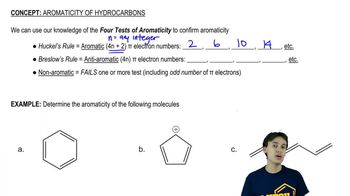
Aromaticity of Hydrocarbons

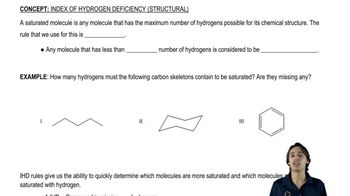
Degree of Unsaturation

The degree of unsaturation indicates the total number of rings and multiple bonds (double or triple) in a hydrocarbon. Each double bond or ring contributes one degree of unsaturation, while each triple bond contributes two. This concept is crucial for calculating the molecular formula, as it helps determine how many hydrogen atoms are present relative to the number of carbon atoms.
Video consigliato:
02:39
The difference between saturated and unsaturated molecules.

Molecular Formula Calculation

The molecular formula of a compound represents the number and types of atoms present. For hydrocarbons, the general formula is CnH(2n+2) for saturated compounds. However, for unsaturated hydrocarbons, adjustments must be made based on the degree of unsaturation. In this case, the presence of 1 triple bond, 2 double bonds, and 1 ring must be accounted for to derive the correct molecular formula from the given number of carbon atoms.
Video consigliato:
00:46
Calculating IHD using molecular formula