Ch. 8 - Delocalized Electrons: Their Effect on Stability, pKa, and the Products of a Reaction • Aromaticity and Electronic Effects: An Introduction to the Reactions of Benzene
Bruice - Organic Chemistry 8th Edition
Bruice8th EditionOrganic ChemistryISBN: 9780135213711Non è quello che usi tu?Cambia libro di testo
Capitolo 8, Problema 46b

Explain why the following compounds are not optically active:
b. the product obtained from the reaction of 1,3-butadiene with trans-1,2-dichloroethene

Guida verificata passo dopo passo
1
Identify the type of reaction occurring between 1,3-butadiene and trans-1,2-dichloroethene. This is a Diels-Alder reaction, which is a [4+2] cycloaddition reaction where the diene (1,3-butadiene) reacts with a dienophile (trans-1,2-dichloroethene) to form a cyclohexene derivative.
Analyze the symmetry of the reactants. Trans-1,2-dichloroethene is symmetric due to the trans arrangement of the chlorine atoms across the double bond. This symmetry will influence the stereochemistry of the product.
Examine the stereochemistry of the product. The Diels-Alder reaction is stereospecific, meaning the stereochemistry of the dienophile is preserved in the product. Since trans-1,2-dichloroethene is symmetric, the product will also have a plane of symmetry.
Determine the optical activity of the product. For a compound to be optically active, it must lack a plane of symmetry and have a chiral center. In this case, the product has a plane of symmetry, making it achiral and therefore not optically active.
Conclude that the product obtained from the reaction of 1,3-butadiene with trans-1,2-dichloroethene is not optically active because it is achiral due to the presence of a plane of symmetry in the molecule.

Risposta video verificata per un problema simile:

Questa soluzione video è stata consigliata dai nostri tutor come utile per risolvere questo problema.
Durata del video:
6m

Concetti chiave

Ecco i concetti essenziali che devi comprendere per rispondere correttamente alla domanda.

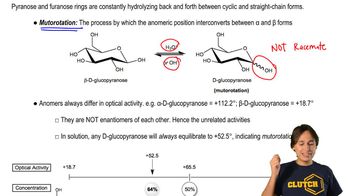
Optical Activity

Optical activity refers to the ability of a compound to rotate the plane of polarized light. This property is typically exhibited by chiral molecules, which lack an internal plane of symmetry and have non-superimposable mirror images. Compounds that are achiral, or have a plane of symmetry, do not exhibit optical activity.
Video consigliato:
08:17
Mutorotation and Optical Activity

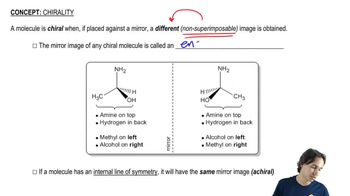
Chirality

Chirality is a geometric property of some molecules that makes them non-superimposable on their mirror images. A chiral molecule usually has at least one carbon atom bonded to four different substituents, creating two enantiomers. In contrast, if a molecule has symmetry or identical substituents, it is achiral and cannot rotate polarized light.
Video consigliato:
05:10
What is chirality?

Reaction Mechanism of 1,3-Butadiene and Trans-1,2-Dichloroethene

The reaction between 1,3-butadiene and trans-1,2-dichloroethene involves a Diels-Alder cycloaddition mechanism, which can lead to the formation of a cyclic compound. The symmetry of the reactants and the resulting product can lead to the formation of a compound that possesses a plane of symmetry, thus rendering it achiral and optically inactive.
Video consigliato:
02:16
Heck Reaction Mechanism