
Ch. 8 - Delocalized Electrons: Their Effect on Stability, pKa, and the Products of a Reaction • Aromaticity and Electronic Effects: An Introduction to the Reactions of Benzene
Bruice - Organic Chemistry 8th Edition
Bruice8th EditionOrganic ChemistryISBN: 9780135213711Non è quello che usi tu?Cambia libro di testo
Capitolo 8, Problema 57a

What orbitals contain the electrons represented as lone pairs in the structures of quinoline, indole, imidazole?

Guida verificata passo dopo passo
1
Step 1: Analyze the structures of quinoline, indole, and imidazole. Quinoline contains a nitrogen atom in a pyridine ring fused to a benzene ring. Indole contains a nitrogen atom in a pyrrole ring fused to a benzene ring. Imidazole contains two nitrogen atoms in a five-membered ring.
Step 2: Determine the hybridization of the nitrogen atoms in each structure. In quinoline, the nitrogen atom is sp2 hybridized because it is part of an aromatic system. In indole, the nitrogen atom is sp2 hybridized as it is part of the aromatic pyrrole ring. In imidazole, one nitrogen is sp2 hybridized (part of the aromatic system), and the other nitrogen is sp2 hybridized but has a lone pair not involved in aromaticity.
Step 3: Identify the orbitals containing the lone pairs. For sp2 hybridized nitrogen atoms, the lone pairs are located in sp2 orbitals. In quinoline, the lone pair on nitrogen resides in an sp2 orbital. In indole, the lone pair on nitrogen also resides in an sp2 orbital. In imidazole, the lone pair on the sp2 nitrogen not involved in aromaticity resides in an sp2 orbital.
Step 4: Consider the aromaticity of the systems. The lone pairs in quinoline and indole do not participate in aromaticity and remain localized in sp2 orbitals. In imidazole, one nitrogen contributes its lone pair to the aromatic π-system, while the other nitrogen's lone pair remains localized in an sp2 orbital.
Step 5: Summarize the findings. The lone pairs in quinoline, indole, and imidazole are located in sp2 orbitals. In imidazole, one nitrogen's lone pair contributes to aromaticity, while the other nitrogen's lone pair remains localized.

Risposta video verificata per un problema simile:

Questa soluzione video è stata consigliata dai nostri tutor come utile per risolvere questo problema.
Durata del video:
10m

Concetti chiave

Ecco i concetti essenziali che devi comprendere per rispondere correttamente alla domanda.

Lone Pairs

Lone pairs are pairs of valence electrons that are not involved in bonding and are localized on a single atom. In organic molecules, they can influence reactivity, molecular geometry, and polarity. Understanding where these lone pairs are located in a molecule is crucial for predicting its chemical behavior and interactions.
Video consigliato:
02:04
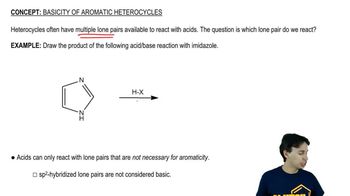
Heterocycles - Which lone pairs react?

Hybridization

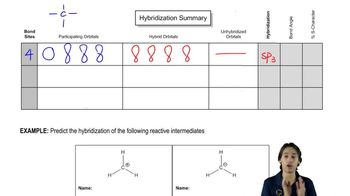
Hybridization is the concept of mixing atomic orbitals to form new hybrid orbitals that can accommodate bonding and lone pairs. In the context of quinoline, indole, and imidazole, recognizing the hybridization of nitrogen atoms helps identify the orbitals that contain lone pairs. For example, sp2 hybridization typically involves one lone pair in a trigonal planar arrangement.
Video consigliato:
10:43
Using bond sites to predict hybridization

Molecular Structure and Resonance

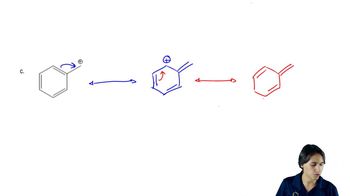
The molecular structure of compounds like quinoline, indole, and imidazole can exhibit resonance, where electrons are delocalized over multiple atoms. This delocalization affects the distribution of lone pairs and can stabilize the molecule. Understanding resonance structures is essential for determining the actual electron distribution and the role of lone pairs in these compounds.
Video consigliato:
03:04
Drawing Resonance Structures