Ch. 8 - Delocalized Electrons: Their Effect on Stability, pKa, and the Products of a Reaction • Aromaticity and Electronic Effects: An Introduction to the Reactions of Benzene
Bruice - Organic Chemistry 8th Edition
Bruice8th EditionOrganic ChemistryISBN: 9780135213711Non è quello che usi tu?Cambia libro di testo
Capitolo 8, Problema 50a

Which compound in each set is aromatic? Explain your choice.
a. Chemical structures of cyclopene, cyclopropenyl cation, and cyclopropenyl anion with labels beneath each.

Guida verificata passo dopo passo
1
Step 1: Recall the criteria for aromaticity. A compound is aromatic if it satisfies the following conditions: (1) It is cyclic, (2) It is planar, (3) It has a conjugated π-electron system, and (4) It follows Huckel's rule, which states that the molecule must have (4n + 2) π-electrons, where n is a non-negative integer.
Step 2: Analyze cyclopropene. Cyclopropene is cyclic and planar, but it has only two π-electrons in its double bond. Since 2 does not satisfy Huckel's rule (4n + 2 = 2 is not possible for any integer n), cyclopropene is not aromatic.
Step 3: Analyze the cyclopropenyl cation. The cation is cyclic and planar, and it has a conjugated π-electron system. The cation has two π-electrons from the double bond and an additional empty p-orbital on the positively charged carbon. This results in a total of 2 π-electrons, which does not satisfy Huckel's rule. Therefore, the cyclopropenyl cation is not aromatic.
Step 4: Analyze the cyclopropenyl anion. The anion is cyclic and planar, and it has a conjugated π-electron system. The anion has two π-electrons from the double bond and two additional π-electrons from the lone pair on the negatively charged carbon. This results in a total of 4 π-electrons, which satisfies Huckel's rule (4n + 2 = 6, where n = 1). Therefore, the cyclopropenyl anion is aromatic.
Step 5: Conclude that among the given compounds, the cyclopropenyl anion is aromatic because it satisfies all the criteria for aromaticity, including Huckel's rule.

Risposta video verificata per un problema simile:

Questa soluzione video è stata consigliata dai nostri tutor come utile per risolvere questo problema.
Durata del video:
6m

Concetti chiave

Ecco i concetti essenziali che devi comprendere per rispondere correttamente alla domanda.

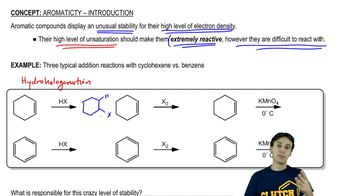
Aromaticity

Aromaticity refers to a property of cyclic compounds that exhibit enhanced stability due to delocalized π electrons. For a compound to be aromatic, it must be cyclic, planar, fully conjugated, and follow Hückel's rule, which states that it should have 4n + 2 π electrons, where n is a non-negative integer.
Video consigliato:
08:19
Intro to Aromaticity

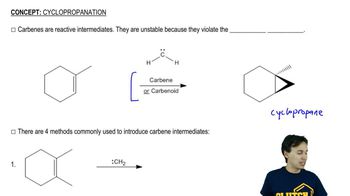
Cyclopropene

Cyclopropene is a three-membered cyclic alkene with one double bond. It does not meet the criteria for aromaticity because it has only two π electrons and is not fully conjugated. Its structure leads to significant angle strain, making it less stable than larger cyclic compounds.
Video consigliato:
01:49
General properties of cyclopropanation.

Cyclopropenyl Cation and Anion

The cyclopropenyl cation and anion are derived from cyclopropene by adding or removing a proton. The cyclopropenyl cation has 2 π electrons and is not aromatic, while the cyclopropenyl anion has 4 π electrons, which also disqualifies it from being aromatic. However, the anion is more stable due to the presence of a negative charge that can be delocalized.
Video consigliato:
Percorso guidato
1:06
Anionic Polymerization Concept 4