
Ch. 8 - Delocalized Electrons: Their Effect on Stability, pKa, and the Products of a Reaction • Aromaticity and Electronic Effects: An Introduction to the Reactions of Benzene
Bruice - Organic Chemistry 8th Edition
Bruice8th EditionOrganic ChemistryISBN: 9780135213711Non è quello che usi tu?Cambia libro di testo
Capitolo 8, Problema 9

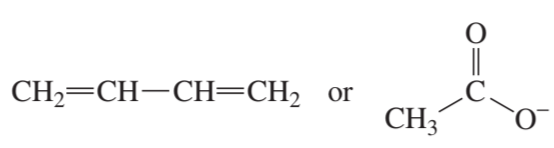
Which has the greater delocalization energy?
Chemical structures comparing delocalization energy: a linear alkene and a resonance-stabilized carboxylate ion.

Guida verificata passo dopo passo
1
Understand the concept of delocalization energy: Delocalization energy refers to the extra stability a molecule gains due to the delocalization of electrons in a conjugated π-system. It is often compared between molecules with resonance structures.
Identify the molecules being compared: To determine which molecule has greater delocalization energy, you need to know the specific molecules or systems in question. For example, benzene versus cyclohexatriene, or two different conjugated systems.
Analyze the resonance structures: Count the number of valid resonance structures for each molecule. A greater number of resonance structures typically indicates greater delocalization energy.
Evaluate the extent of conjugation: Check the extent of conjugation in the π-system. Molecules with extended conjugation (e.g., polyenes or aromatic systems) generally have higher delocalization energy compared to those with limited conjugation.
Consider aromaticity: If one of the molecules is aromatic (follows Hückel's rule, 4n+2 π-electrons), it will have significantly greater delocalization energy compared to a non-aromatic or anti-aromatic molecule.

Risposta video verificata per un problema simile:

Questa soluzione video è stata consigliata dai nostri tutor come utile per risolvere questo problema.

Concetti chiave

Ecco i concetti essenziali che devi comprendere per rispondere correttamente alla domanda.

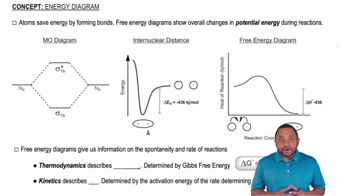
Delocalization Energy

Delocalization energy refers to the stabilization that occurs when electrons are spread out over several atoms rather than being localized between two. This phenomenon is commonly observed in conjugated systems and aromatic compounds, where pi electrons can move freely across multiple adjacent p-orbitals, leading to lower energy states and increased stability.
Video consigliato:
08:30
Introduction to free energy diagrams.

Resonance Structures

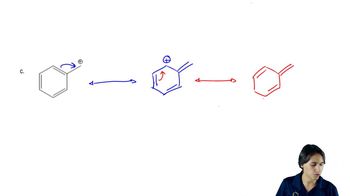
Resonance structures are different Lewis structures for the same molecule that depict the delocalization of electrons. These structures help illustrate how electrons are not fixed in one position but are distributed across multiple bonds, contributing to the overall stability and energy of the molecule. The true structure is a hybrid of these resonance forms.
Video consigliato:
03:04
Drawing Resonance Structures

Aromaticity

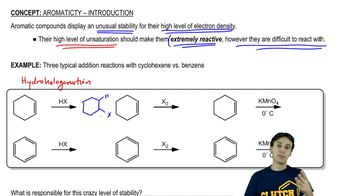
Aromaticity is a property of cyclic compounds that exhibit enhanced stability due to delocalized pi electrons. For a compound to be aromatic, it must follow Huckel's rule, which states that it must have a planar structure and contain a specific number of pi electrons (4n + 2). Aromatic compounds typically have greater delocalization energy compared to non-aromatic compounds.
Video consigliato:
08:19
Intro to Aromaticity