
Ch. 9 - Substitution and Elimination Reactions of Alkyl Halides
Bruice - Organic Chemistry 8th Edition
Bruice8th EditionOrganic ChemistryISBN: 9780135213711Non è quello che usi tu?Cambia libro di testo
Capitolo 9, Problema 4

Does increasing the energy barrier for an SN2 reaction increase or decrease the magnitude of the rate constant for the reaction?

Guida verificata passo dopo passo
1
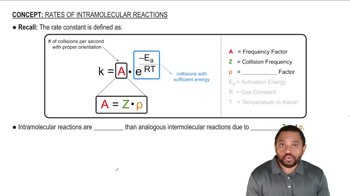
Understand the relationship between the energy barrier and the rate constant: The rate constant (k) for a reaction is related to the activation energy (Ea) through the Arrhenius equation: k=A⁢e−EaRT, where A is the pre-exponential factor, R is the gas constant, and T is the temperature.
Recognize that the energy barrier corresponds to the activation energy (Ea): In an SN2 reaction, the energy barrier is the energy required to reach the transition state from the reactants. A higher energy barrier means a larger Ea.
Analyze the effect of increasing Ea on the rate constant: From the Arrhenius equation, as Ea increases, the exponential term e−EaRT decreases, which in turn decreases the value of k.
Conclude the relationship: Increasing the energy barrier (Ea) decreases the magnitude of the rate constant (k) for the SN2 reaction because the reaction becomes slower as it requires more energy to overcome the activation energy.
Relate this to reaction conditions: To counteract the effect of a higher energy barrier, one could increase the temperature (T) in the Arrhenius equation, as a higher temperature would increase the rate constant despite a higher Ea.

Risposta video verificata per un problema simile:

Questa soluzione video è stata consigliata dai nostri tutor come utile per risolvere questo problema.
Durata del video:
4m

Concetti chiave

Ecco i concetti essenziali che devi comprendere per rispondere correttamente alla domanda.

SN2 Reaction Mechanism

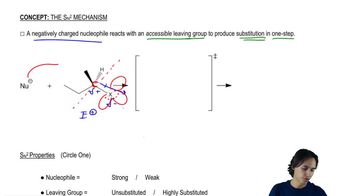
The SN2 (substitution nucleophilic bimolecular) reaction is a type of nucleophilic substitution where a nucleophile attacks an electrophile, resulting in the simultaneous displacement of a leaving group. This reaction occurs in a single concerted step, meaning that bond formation and bond breaking happen simultaneously. The rate of an SN2 reaction depends on the concentration of both the nucleophile and the substrate, making it a second-order reaction.
Video consigliato:
08:33
Drawing the SN2 Mechanism

Activation Energy and Rate Constant

Activation energy is the minimum energy required for a reaction to occur. According to the Arrhenius equation, the rate constant (k) of a reaction is inversely related to the activation energy; as the energy barrier increases, the rate constant decreases. This relationship highlights how higher activation energy makes it less likely for reactants to successfully collide with enough energy to form products, thus slowing the reaction.
Video consigliato:
Percorso guidato
2:29
Rates of Intramolecular Reactions Concept 1

Effect of Energy Barrier on Reaction Rate

The energy barrier of a reaction directly influences its rate. In the context of an SN2 reaction, increasing the energy barrier means that fewer molecules will have sufficient energy to overcome this barrier, leading to a decrease in the rate of reaction. Consequently, as the energy barrier rises, the magnitude of the rate constant decreases, indicating a slower reaction rate.
Video consigliato:
Percorso guidato
2:29
Rates of Intramolecular Reactions Concept 1
Pratica correlata
Domanda del libro di testo

How will the rate of the reaction between bromomethane and hydroxide ion be affected if the following changes in concentration are made?

c. The concentration of the alkyl halide is cut in half and the concentration of the nucleophile is doubled.

1044
views
Domanda del libro di testo

How will the rate of the reaction between bromomethane and hydroxide ion be affected if the following changes in concentration are made?

a. The concentration of the alkyl halide is not changed and the concentration of the nucleophile is tripled.

1165
views
Domanda del libro di testo

A small amount of another organic product is formed in a Williamson ether synthesis. What is this product when the alkyl halide used in the synthesis of butyl propyl ether is

a. propyl bromide?

1255
views
Domanda del libro di testo

How will the rate of the reaction between bromomethane and hydroxide ion be affected if the following changes in concentration are made?

b. The concentration of the alkyl halide is cut in half and the concentration of the nucleophile is not changed.

1223
views
Domanda del libro di testo

A small amount of another organic product is formed in a Williamson ether synthesis. What is this product when the alkyl halide used in the synthesis of butyl propyl ether is

b. butyl bromide?

1419
views
Domanda del libro di testo

Rank the following alkyl bromides from most reactive to least reactive in an SN2 reaction:

1-bromo-2-methylbutane, 1-bromo-3-methylbutane, 2-bromo-2-methylbutane, and 1-bromopentane.

1705
views