Ch. 9 - Substitution and Elimination Reactions of Alkyl Halides
Bruice - Organic Chemistry 8th Edition
Bruice8th EditionOrganic ChemistryISBN: 9780135213711Non è quello che usi tu?Cambia libro di testo
Capitolo 9, Problema 47b

Draw the elimination products that are formed when 3-bromo-3-methyl-1-butene reacts with
b. CH3OH

Guida verificata passo dopo passo
1
Step 1: Identify the type of reaction. The given reaction involves 3-bromo-3-methyl-1-butene reacting with CH3OH, which suggests a nucleophilic substitution or elimination reaction. Since CH3OH is a weak nucleophile and base, the reaction is likely to proceed via an elimination mechanism (E1).
Step 2: Analyze the structure of the substrate. The substrate, 3-bromo-3-methyl-1-butene, contains a bromine atom attached to a tertiary carbon. Tertiary carbons are highly favorable for E1 reactions due to the stability of the carbocation intermediate formed after the loss of the leaving group (Br⁻).
Step 3: Determine the first step of the E1 mechanism. The bromine atom leaves, forming a tertiary carbocation at the 3rd carbon. This step is the rate-determining step and results in a positively charged intermediate.
Step 4: Consider the elimination step. A proton (H⁺) is removed from a β-carbon (adjacent to the carbocation) by the weak base (CH3OH). The elimination of H⁺ leads to the formation of a double bond. Since the substrate already contains a double bond, the elimination will extend conjugation or form a new double bond in the molecule.
Step 5: Predict the product. The elimination will result in the formation of an alkene product. The most stable alkene product will be formed, considering factors such as conjugation and hyperconjugation. The product will likely be a conjugated diene due to the stability provided by conjugation.

Risposta video verificata per un problema simile:

Questa soluzione video è stata consigliata dai nostri tutor come utile per risolvere questo problema.
Durata del video:
3m

Concetti chiave

Ecco i concetti essenziali che devi comprendere per rispondere correttamente alla domanda.

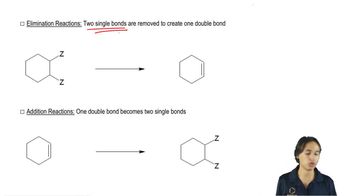
Elimination Reactions

Elimination reactions involve the removal of atoms or groups from a molecule, resulting in the formation of a double bond or a ring structure. In this context, the reaction of 3-bromo-3-methyl-1-butene with CH3OH can lead to the elimination of HBr, forming an alkene. Understanding the mechanism of elimination, such as E2 or E1 pathways, is crucial for predicting the products.
Video consigliato:
00:40
Recognizing Elimination Reactions.

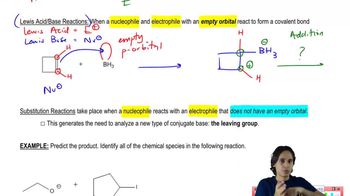
Nucleophilic Substitution

Nucleophilic substitution is a fundamental reaction in organic chemistry where a nucleophile replaces a leaving group in a molecule. In this case, CH3OH acts as a nucleophile that can attack the carbon atom bonded to the bromine in 3-bromo-3-methyl-1-butene. Recognizing the conditions under which substitution occurs versus elimination is essential for determining the major products of the reaction.
Video consigliato:
01:47
Nucleophiles and Electrophiles can react in Substitution Reactions.

Regioselectivity and Stereochemistry

Regioselectivity refers to the preference of a chemical reaction to yield one structural isomer over others, while stereochemistry involves the spatial arrangement of atoms in molecules. In the reaction of 3-bromo-3-methyl-1-butene with CH3OH, understanding which carbon atoms are involved in the elimination and substitution processes helps predict the regio- and stereochemical outcomes of the products formed.
Video consigliato:
Percorso guidato
1:38
Polymer Stereochemistry Concept 1