Ch. 9 - Substitution and Elimination Reactions of Alkyl Halides
Bruice - Organic Chemistry 8th Edition
Bruice8th EditionOrganic ChemistryISBN: 9780135213711Non è quello che usi tu?Cambia libro di testo
Capitolo 9, Problema 73a

Starting with cyclohexene, how can the following compounds be prepared?
a. methoxycyclohexane

Guida verificata passo dopo passo
1
Step 1: Begin with cyclohexene, which is a six-membered ring with one double bond. The goal is to convert this into methoxycyclohexane, which involves adding a methoxy group (OCH₃) to the cyclohexane ring.
Step 2: The first step in the transformation is to perform an electrophilic addition reaction to convert the alkene (cyclohexene) into an alcohol. This can be achieved by using an oxymercuration-demercuration reaction. Add mercuric acetate (Hg(OAc)₂) in the presence of water to form a mercurinium ion intermediate.
Step 3: The mercurinium ion is then attacked by water, leading to the formation of an organomercury alcohol intermediate. This step effectively adds an OH group to the more substituted carbon of the double bond, following Markovnikov's rule.
Step 4: To remove the mercury and complete the conversion to an alcohol, treat the intermediate with sodium borohydride (NaBH₄). This step reduces the organomercury compound to yield cyclohexanol.
Step 5: Finally, convert cyclohexanol to methoxycyclohexane by performing a nucleophilic substitution reaction. React cyclohexanol with methanol (CH₃OH) in the presence of an acid catalyst, such as sulfuric acid (H₂SO₄), to facilitate the substitution of the hydroxyl group with a methoxy group, forming methoxycyclohexane.

Risposta video verificata per un problema simile:

Questa soluzione video è stata consigliata dai nostri tutor come utile per risolvere questo problema.
Durata del video:
3m

Concetti chiave

Ecco i concetti essenziali che devi comprendere per rispondere correttamente alla domanda.

Electrophilic Addition Reactions

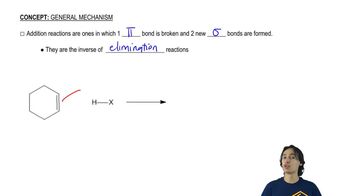
Electrophilic addition reactions are fundamental in organic chemistry, particularly for alkenes like cyclohexene. In these reactions, an electrophile reacts with the double bond of the alkene, resulting in the formation of a more saturated compound. Understanding this mechanism is crucial for synthesizing products like methoxycyclohexane from cyclohexene.
Video consigliato:
05:39
Features of Addition Mechanisms.

Nucleophilic Substitution

Nucleophilic substitution is a key reaction type where a nucleophile replaces a leaving group in a molecule. In the context of preparing methoxycyclohexane, a nucleophile such as methoxide can attack a suitable electrophilic center formed after the initial addition reaction. This concept is essential for understanding how to introduce functional groups into organic molecules.
Video consigliato:
01:47
Nucleophiles and Electrophiles can react in Substitution Reactions.

Reagents and Reaction Conditions

The choice of reagents and reaction conditions significantly influences the outcome of organic reactions. For the synthesis of methoxycyclohexane, specific reagents like methanol and an acid catalyst may be required to facilitate the nucleophilic substitution. Familiarity with these reagents and their roles is vital for successful organic synthesis.
Video consigliato:
01:52
Reagents