Ch. 9 - Substitution and Elimination Reactions of Alkyl Halides
Bruice - Organic Chemistry 8th Edition
Bruice8th EditionOrganic ChemistryISBN: 9780135213711Non è quello che usi tu?Cambia libro di testo
Capitolo 9, Problema 61c,d

What is the best way to prepare the following ethers using an alkyl halide and an alkoxide ion?
c.
d.

Guida verificata passo dopo passo
1
Step 1: Identify the ether structure and determine the two components needed for its synthesis: an alkyl halide and an alkoxide ion. For the first ether (cyclohexyl methyl ether), the components are cyclohexyl bromide (alkyl halide) and methoxide ion (alkoxide). For the second ether (benzyl ether), the components are benzyl bromide (alkyl halide) and phenoxide ion (alkoxide).
Step 2: Recall the Williamson Ether Synthesis mechanism, which involves the reaction of an alkoxide ion with an alkyl halide via an SN2 mechanism. This reaction works best with primary alkyl halides to avoid steric hindrance and side reactions.
Step 3: For cyclohexyl methyl ether, prepare the methoxide ion by reacting methanol (CH3OH) with a strong base like sodium hydride (NaH) or sodium metal (Na). This generates CH3O⁻, the alkoxide ion. Then, react CH3O⁻ with cyclohexyl bromide (C6H11Br) under appropriate conditions to form the ether.
Step 4: For benzyl ether, prepare the phenoxide ion by reacting phenol (C6H5OH) with a strong base like sodium hydride (NaH) or sodium metal (Na). This generates C6H5O⁻, the alkoxide ion. Then, react C6H5O⁻ with benzyl bromide (C6H5CH2Br) under appropriate conditions to form the ether.
Step 5: Ensure the reaction conditions are optimized for SN2 reactions, such as using polar aprotic solvents (e.g., DMSO or acetone) and avoiding steric hindrance in the alkyl halide. Monitor the reaction progress and purify the product using standard organic chemistry techniques like distillation or chromatography.

Risposta video verificata per un problema simile:

Questa soluzione video è stata consigliata dai nostri tutor come utile per risolvere questo problema.
Durata del video:
4m

Concetti chiave

Ecco i concetti essenziali che devi comprendere per rispondere correttamente alla domanda.

Ethers

Ethers are organic compounds characterized by an oxygen atom bonded to two alkyl or aryl groups. They are generally formed through the reaction of an alkyl halide with an alkoxide ion, which acts as a nucleophile. Understanding the structure and properties of ethers is essential for determining the appropriate reaction conditions and reagents for their synthesis.
Video consigliato:
04:22
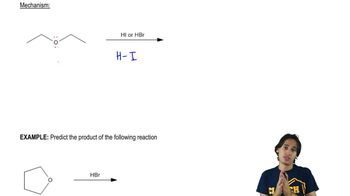
How to predict the products of Ether Cleavage.

Alkyl Halides

Alkyl halides are organic compounds containing a carbon atom bonded to a halogen atom (such as chlorine, bromine, or iodine). They serve as electrophiles in nucleophilic substitution reactions, where the halogen is replaced by a nucleophile, such as an alkoxide ion. Recognizing the reactivity of different alkyl halides is crucial for predicting the outcome of ether synthesis.
Video consigliato:
01:52
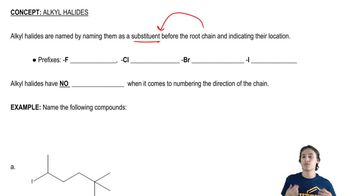
How to name alkyl halides

Alkoxide Ions

Alkoxide ions are deprotonated alcohols, represented as R-O⁻, where R is an alkyl group. They are strong nucleophiles and are commonly used in the synthesis of ethers through nucleophilic substitution reactions with alkyl halides. Understanding the role of alkoxide ions in these reactions helps in selecting the right conditions for effective ether preparation.
Video consigliato:
Percorso guidato
3:39
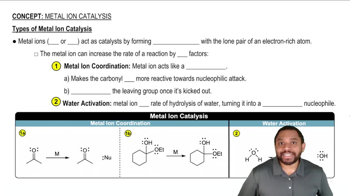
Metal Ion Catalysis Concept 1