Indietro
 Mullins 1st EditionCh. 13 - Alcohols, Ethers and Related Compounds: Substitution and Elimination
Problema 73c
Identify the alkene and alcohol partners that could be used to make the following ethers.
(c)
Problema 74a
Predict the products of the following reactions.
(a)
Problema 74b
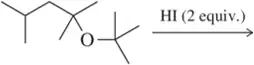
Predict the products of the following reactions.
(b)
Problema 74c
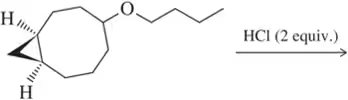
Predict the products of the following reactions.
(c)
Problema 75
Show an arrow-pushing mechanism that rationalizes formation of the two products. Which C―O bond will break first? Why?
Problema 76
Predict the alcohol and haloalkane that will form upon reaction of the ether shown with one equivalent of HBr. [Hint: Think carefully about which side will become the halide.]
Problema 77
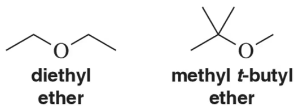
Methyl t-butyl ether (MTBE) is used preferentially over diethyl ether because it is less prone to form peroxides. Explain this observation in terms of the two structures.
Problema 78a
Predict the product of the following reactions.
(a)
Problema 80a
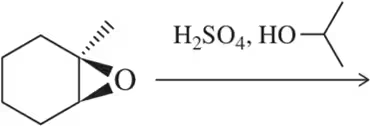
Predict the product of the following epoxide addition reactions.
(a)
Problema 80b
Predict the product of the following epoxide addition reactions.
(b)
Problema 81b
A variety of organometallics, which as strong nucleophiles can react with epoxides, are introduced in Chapter 16. Predict the product of these reactions. [Hint: Assume the carbon–metal bond in each is ionic, with the carbon possessing the negative charge.]
(b)
Problema 81c
A variety of organometallics, which as strong nucleophiles can react with epoxides, are introduced in Chapter 16. Predict the product of these reactions. [Hint: Assume the carbon–metal bond in each is ionic, with the carbon possessing the negative charge.]
(c)
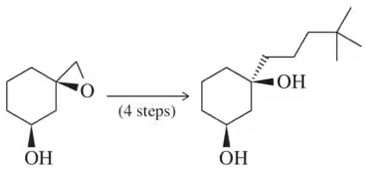
Problema 83
Reaction of the acetylide with the epoxide shown will not form the desired product. What side reaction occurs instead? Why?
Problema 84a
Show how a protecting group might be used to make these reactions successful.
(a)
Problema 84b
Show how a protecting group might be used to make these reactions successful.
(b)
Problema 86b
Using IUPAC rules, name the following molecules.
(b)
Problema 86d
Using IUPAC rules, name the following molecules.
(d)
Problema 86e
Using IUPAC rules, name the following molecules.
(e)
Problema 87a
Draw the correct structure from the following IUPAC names:
(a) (4R,2Z)-4-methylhex-2-en-1-ol
Problema 87b
Draw the correct structure from the following IUPAC names:
(b) 4-methoxybut-1-yne
Problema 87c
Draw the correct structure from the following IUPAC names:
(c) (1S,4R)-4-bromocyclohex-2-en-1-ol
Problema 87d
Draw the correct structure from the following IUPAC names:
(d) (2R,3S)-methoxy-3-methylpentane
Problema 87e
Draw the correct structure from the following IUPAC names:
(e) (R)-2,2-dimethyl-1-phenylpropane-1-thiol
Problema 87f
Draw the correct structure from the following IUPAC names:
(f) (S)-4-isopropoxypent-2-yne.
Problema 88a(ii)
Predict the product(s) that would result when the following molecules are allowed to react under the following conditions: (ii) 1. Hg(OAc)2 2. NaBH4.If there is no reaction, write 'no reaction.'
(a)
Problema 88a(i)
Predict the product(s) that would result when the following molecules are allowed to react under the following conditions: (i) 1. BH3 2. NaOH, H2O2. If there is no reaction, write 'no reaction.'
(a)
Problema 88a(v)
Predict the product(s) that would result when the following molecules are allowed to react under the following conditions: (v) H2O. If there is no reaction, write 'no reaction.'
(a)
Problema 88a(iv)
Predict the product(s) that would result when the following molecules are allowed to react under the following conditions: (iv) 1. OsO4 2. NaHSO3. If there is no reaction, write 'no reaction.'
(a)
Problema 88a(vi)
Predict the product(s) that would result when the following molecules are allowed to react under the following conditions: (vi) NaOH, H2O . If there is no reaction, write 'no reaction.'
(a)
Problema 88a(iii)
Predict the product(s) that would result when the following molecules are allowed to react under the following conditions: (iii) H2SO4 , H2O . If there is no reaction, write 'no reaction.'
(a)