Indietro
 Mullins 1st EditionCh. 13 - Alcohols, Ethers and Related Compounds: Substitution and Elimination
Problema 1
Rank the ability of the following compounds to undergo an S_N1 reaction ( 1 = fastest, 5 = slowest ).
Problema 2
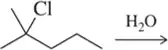
Provide a mechanism for the following SN1 reaction. What roles (acid/base/nucleophile/electrophile) does ethanol play in the reaction? What functional group is made in this reaction?
Problema 4a
Use oxidation numbers to determine whether the following are redox reactions.
(a)
Problema 4b
Use oxidation numbers to determine whether the following are redox reactions.
(b)
Problema 5a
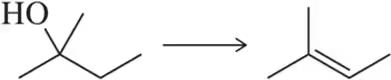
The mechanism of the acid-catalyzed hydration of an alkene to make an alcohol is shown. If this reaction is reversible, draw a mechanism that justifies formation of the alkene from the alcohol under similar conditions. How do you know this mechanism is correct?
Problema 6a
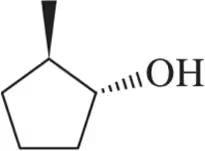
Provide the IUPAC name for the following molecules.
(a)
Problema 6b
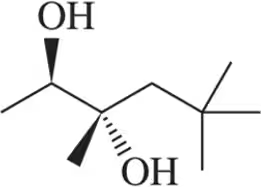
Provide the IUPAC name for the following molecules.
(b)
Problema 6f
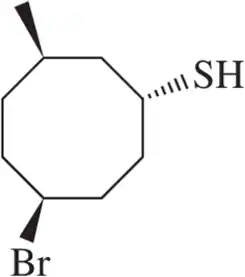
Provide the IUPAC name for the following molecules.
(f)
Problema 7a
Draw the structure that corresponds to the name provided.
(a) (1R,5S)-5-methylcyclohex-3-enol
Problema 7b
Draw the structure that corresponds to the name provided.
(b) (2R,3R,4S)-heptane-2,3,4-triol
Problema 7c
Draw the structure that corresponds to the name provided.
(c) (2E,4S,6Z)-octa-2,6-dien-4-ol
Problema 7d
Draw the structure that corresponds to the name provided.
(d) (2R,4Z)-5-bromopent-4-ene-1,2-diol
Problema 7e
Draw the structure that corresponds to the name provided.
(e) (1S,4S)-4-isopropylcyclopent-2-enethiol
Problema 8
Label each hydroxyl group in Assessment 13.6 as primary (1°) secondary (2°) , or tertiary (3°)
Problema 9
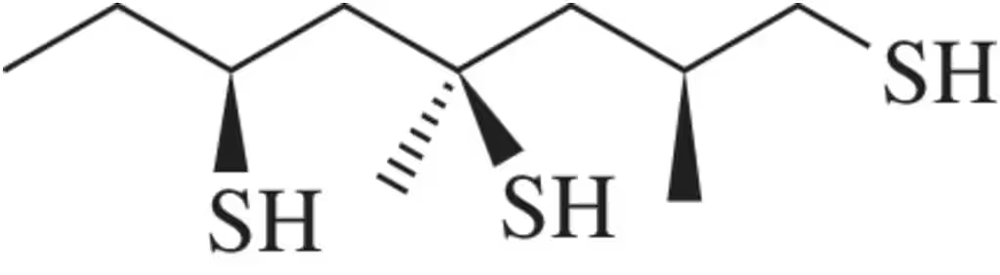
Label each sulfhydryl group as primary (1°) secondary (2°) , or tertiary (3°)
Problema 10
Identify the substitution of carbons (a)–(d) comprising the ether functional group in the following molecules.
Problema 12
Show a mechanism for each of the alcohol synthesis reactions in Table 13.8.
<IMAGE>
Problema 13a
Predict the product of each of the following alcohol synthesis reactions.
(a)
Problema 13b
Predict the product of each of the following alcohol synthesis reactions.
(b)
Problema 13c
Predict the product of each of the following alcohol synthesis reactions.
(c)
Problema 13d
Predict the product of each of the following alcohol synthesis reactions.
(d)
Problema 14a
Suggest a reagent to carry out each of the following conversions to an alcohol.
(a)
Problema 14b
Suggest a reagent to carry out each of the following conversions to an alcohol.
(b)
Problema 14c
Suggest a reagent to carry out each of the following conversions to an alcohol.
(c)
Problema 14d
Suggest a reagent to carry out each of the following conversions to an alcohol.
(d)
Problema 15a
Suggest a reagent and a reactant that could be combined to make each of the following alcohols.
(a)
Problema 15b
Suggest a reagent and a reactant that could be combined to make each of the following alcohols.
(b)
Problema 15c
Suggest a reagent and a reactant that could be combined to make each of the following alcohols.
(c)
Problema 15d
Suggest a reagent and a reactant that could be combined to make each of the following alcohols.
(d)
Problema 16
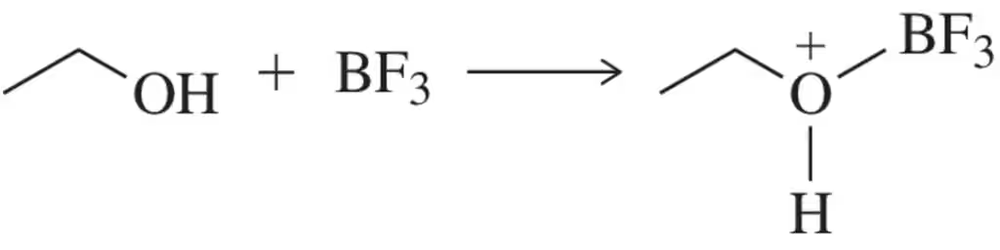
Suggest an arrow-pushing mechanism for the following reaction. Is the hydroxyl group acting as a base, acid, Lewis base, or Lewis acid?