Indietro
 Mullins 1st EditionCh. 13 - Alcohols, Ethers and Related Compounds: Substitution and Elimination
Problema 57a
Fill in the missing reactant, reagent, or product for each of the following oxidation reactions.
(a)
Problema 57b
Fill in the missing reactant, reagent, or product for each of the following oxidation reactions.
(b)
Problema 57c
Fill in the missing reactant, reagent, or product for each of the following oxidation reactions.
(c)
Problema 57d
Fill in the missing reactant, reagent, or product for each of the following oxidation reactions. react similarly to chromic acid
(d)
Problema 57f
Fill in the missing reactant, reagent, or product for each of the following oxidation reactions.
(f)
Problema 58
In Hinkley, the cleanup continues today. In one process PG&E is using to mitigate the chromium(VI) toxicity, ethanol is injected into the soil. How would this reduce the chromium(VI) contamination?
Problema 59a
Predict the product of the following oxidation reactions.
(a)
Problema 59b
Predict the product of the following oxidation reactions.
(b)
Problema 59c
Predict the product of the following oxidation reactions.
(c)
Problema 59d
Predict the product of the following oxidation reactions.
(d)
Problema 60
δ-Hydroxyaldehydes are in equilibrium with their hemiacetal form. Predict the product that would form upon treatment of the hemiacetal with Dess–Martin periodinane.
Problema 61a
Predict the product of the following reactions.
(a)
Problema 61b
Predict the product of the following reactions.
(b)
Problema 62
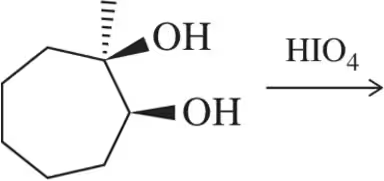
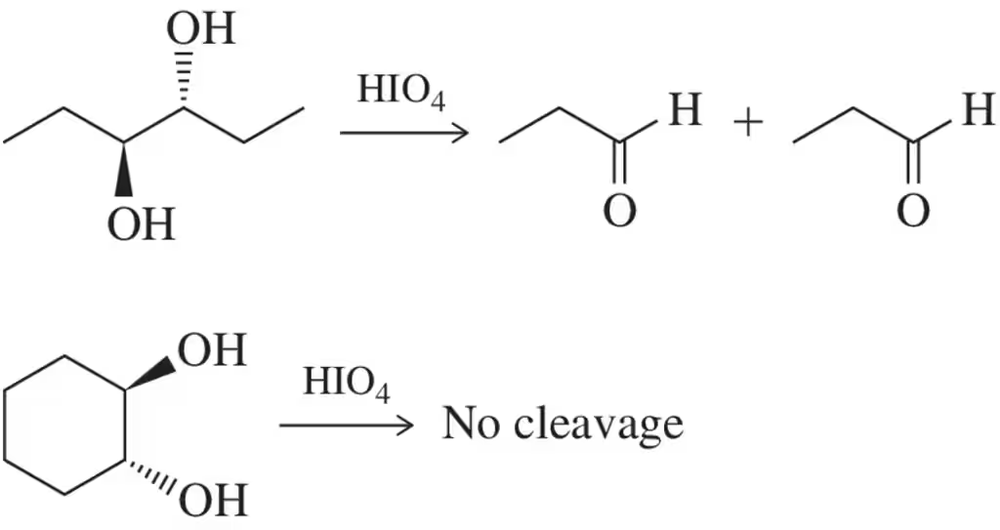
Although trans-diols in rings cannot be cleaved using HIO₄ acyclic trans-diols can. Explain this discrepancy.
Problema 63a(ii)
Propose a synthesis of the carbonyl(s) using the (ii) dihydroxylation/periodic acid cleavage pathways.
(a)
Problema 63a(i)
Propose a synthesis of the carbonyl(s) using the (i) ozonolysis pathways.
(a)
Problema 63b(ii)
Propose a synthesis of the carbonyl(s) using the (ii) dihydroxylation/periodic acid cleavage pathways.
(b)
Problema 63b(i)
Propose a synthesis of the carbonyl(s) using the (i) ozonolysis pathways.
(b)
Problema 64
Unfortunately, the use of NMO creates an additional green chemistry problem. What is the problem and how might it be solved?
Problema 65
Ethers can be converted into radicals, some more easily than others. Which of the following radicals is more stable, and thus, more likely to form?
Problema 66a
Predict the product of the following reactions. [Two of them are Williamson ether syntheses. Why isn't the other?].
(a)
Problema 66b
Predict the product of the following reactions. [Two of them are Williamson ether syntheses. Why isn't the other?].
(b)
Problema 66c
Predict the product of the following reactions. [Two of them are Williamson ether syntheses. Why isn't the other?].
(c)
Problema 67a
Two different Williamson ether syntheses can be used to make the compound in (a). Show them. The compound in (b), however, can only be made one way. Show it and explain why a second Williamson ether synthesis is not possible.
(a)
Problema 68
Why is the SN1 reaction shown an inefficient way of synthesizing ethers?
Problema 69
Starting with hydrogen sulfide, suggest a synthesis of the following thioether that makes use of two different haloalkanes.
Problema 70
How could the reaction in Figure 13.67(b) be modified to produce the following ether?
Problema 71
Predict the product and show an arrow-pushing mechanism for the first step of the alkoxymercuration reaction.
Problema 72
Draw a reaction coordinate diagram for the acid-catalyzed addition of an alcohol to an alkene. Which step is rate-determining?
Problema 73a
Identify the alkene and alcohol partners that could be used to make the following ethers.
(a)