Indietro
Problema 32a,b,c
Draw the structures of the following compounds. (Includes both new and old names.)
(a) triphenylmethanol
(b) 4-(chloromethyl)heptan-3-ol
(c) 2-cyclohexen-1-ol
Problema 32d,e
Draw the structures of the following compounds. (Includes both new and old names.)
(d) 3-cyclopentylhexan-3-ol
(e) meso-2,4-pentanediol
Problema 32i,j
Draw the structures of the following compounds. (Includes both new and old names.)
i. cyclopent-3-ene-1-thiol
j. dimethyl disulfide
Problema 32k
Draw the structures of the following compounds. (Includes both new and old names.)
(k) 3-methylhex-4-yn-2-ol
Problema 33a,b
Predict which member of each pair has the higher boiling point, and explain the reasons for your predictions.
a. hexan-1-ol or 3,3-dimethylbutan-1-ol
b. hexan-2-one or hexan-2-ol
Problema 34a
Predict which member of each pair is more acidic, and explain the reasons for your predictions.
a. cyclopentanol or 3-chlorophenol
Problema 34b
Predict which member of each pair is more acidic, and explain the reasons for your predictions.
b. cyclohexanol or cyclohexanethiol
Problema 35a
Predict which member of each group is most soluble in water, and explain the reasons for your predictions.
a. butan-1-ol, pentan-1-ol, or propan-2-ol
Problema 35b
Predict which member of each group is most soluble in water, and explain the reasons for your predictions.
b. chlorocyclohexane, cyclohexanol, or cyclohexane-1,2-diol
Problema 36a,b
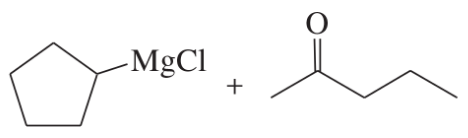
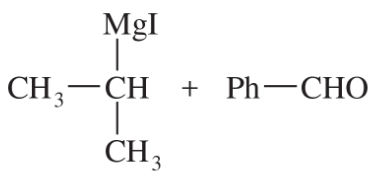
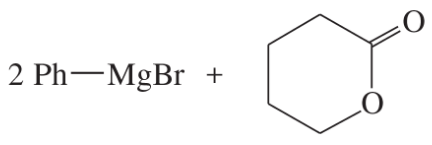
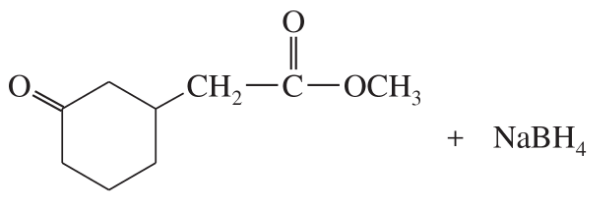
Draw the organic products you would expect to isolate from the following reactions (after hydrolysis).
(a)
(b)
Problema 36c,d
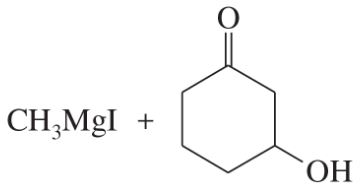
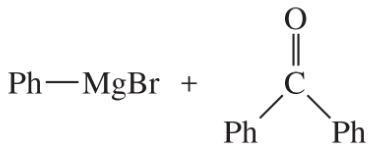
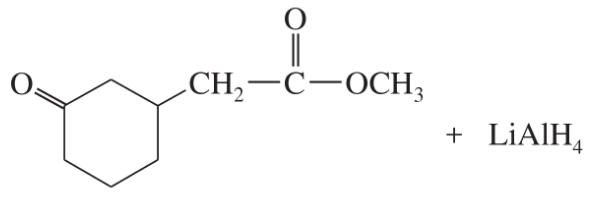
Draw the organic products you would expect to isolate from the following reactions (after hydrolysis).
(c)
(d)
Problema 36f,g
Draw the organic products you would expect to isolate from the following reactions (after hydrolysis).
(f)
(g)
Problema 36j
Draw the organic products you would expect to isolate from the following reactions (after hydrolysis).
(j)
Problema 36k,l
Draw the organic products you would expect to isolate from the following reactions (after hydrolysis).
(k)
(l)
Problema 36m
Draw the organic products you would expect to isolate from the following reactions (after hydrolysis).
(m)
Problema 36n
Draw the organic products you would expect to isolate from the following reactions (after hydrolysis).
(n)
Problema 36p
Draw the organic products you would expect to isolate from the following reactions (after hydrolysis).
(p)
Problema 37a
Starting from bromobenzene and any other reagents and solvents you need, show how you would synthesize the following compounds. Any of these products may be used as starting materials in subsequent parts of this problem.
a. 1-phenylpropan-1-ol
Problema 37b
Starting from bromobenzene and any other reagents and solvents you need, show how you would synthesize the following compounds. Any of these products may be used as starting materials in subsequent parts of this problem.
b. 1-phenylpropene
Problema 37c
Starting from bromobenzene and any other reagents and solvents you need, show how you would synthesize the following compounds. Any of these products may be used as starting materials in subsequent parts of this problem.
c. 1-phenylpropan-2-ol
Problema 37d
Starting from bromobenzene and any other reagents and solvents you need, show how you would synthesize the following compounds. Any of these products may be used as starting materials in subsequent parts of this problem.
d. 3-phenylprop-2-en-1-ol
Problema 38
Write structures for a homologous series of alcohols (R―OH) having from one to six carbons.
Problema 38a
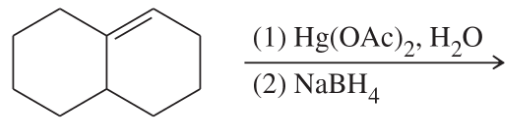
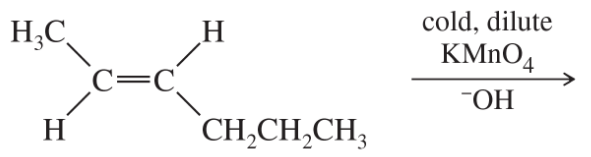
Show how you would synthesize the following alcohol from appropriate alkene.
(a)
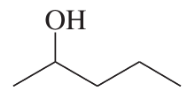
Problema 38b
Show how you would synthesize the following alcohol from appropriate alkene.
(b)
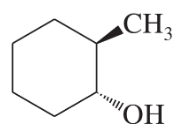
Problema 38d
Show how you would synthesize the following alcohol from appropriate alkene.
(d)
Problema 39a
Show how you would use Grignard syntheses to prepare the following alcohol from the indicated starting material and any other necessary reagents.
(a) octan-3-ol from hexanal, CH3(CH2)4CHO
Problema 39d
Show how you would use Grignard syntheses to prepare the following alcohol from the indicated starting material and any other necessary reagents.
(d) 2-cyclohexylethanol from bromocyclohexane
Problema 39e
Show how you would use Grignard syntheses to prepare the following alcohol from the indicated starting material and any other necessary reagents.
(e) benzyl alcohol (Ph–CH2–OH) from bromobenzene (Ph–Br)
Problema 39g
Show how you would use Grignard syntheses to prepare the following alcohol from the indicated starting material and any other necessary reagents.
(g) cyclopentylphenylmethanol from benzaldehyde (Ph–CHO)
Problema 40b
Show how you would accomplish the following transformations. You may use any additional reagents you need.
(b)