Indietro
Problema 19
Draw the important resonance contributors for both resonance-stabilized cations (in brackets) in the mechanism for acid-catalyzed hydrolysis of an amide.
Problema 20.21
Show how the following ketones might be synthesized from the indicated acids, using any necessary reagents.
(a) propiophenone from propionic acid (using Friedel–Crafts acylation)
Problema 20a
Propose a mechanism for the hydrolysis of N,N-dimethylacetamide
(a) under basic conditions.
Problema 20b
Propose a mechanism for the hydrolysis of N,N-dimethylacetamide
(b) under acidic conditions.
Problema 22
Propose a mechanism for the basic hydrolysis of benzonitrile to the benzoate ion and ammonia.
Problema 23
The mechanism for acidic hydrolysis of a nitrile resembles the basic hydrolysis, except that the nitrile is first protonated, activating it toward attack by a weak nucleophile (water). Under acidic conditions, the proton transfer (tautomerism) involves protonation on nitrogen followed by deprotonation on oxygen. Propose a mechanism for the acid-catalyzed hydrolysis of benzonitrile to benzamide.
Problema 24a
In which step(s) of the hydride reduction of an ester does the compound undergo reduction? (Hint: Count the bonds to oxygen.)
Problema 24b
Propose a mechanism for the reduction of octanoyl chloride by lithium aluminum hydride.
Problema 26
Draw a mechanism for the acidic hydrolysis of the magnesium salt shown below to acetophenone.
Problema 27
Draw a mechanism for the reaction of propanoyl chloride with 2 moles of phenylmagnesium bromide.
Problema 28a
Show how you would add a Grignard reagent to an ester or a nitrile to synthesize
(a) 4-phenylheptan-4-ol.
Problema 28b
Show how you would add a Grignard reagent to an ester or a nitrile to synthesize
(b) heptan-4-ol.
Problema 28c
Show how you would add a Grignard reagent to an ester or a nitrile to synthesize
(c) pentan-2-one.
Problema 30a
Show how Friedel–Crafts acylation might be used to synthesize the following compounds.
a. acetophenone
Problema 30b
Show how Friedel–Crafts acylation might be used to synthesize the following compounds.
b. benzophenone
Problema 30c
Show how Friedel–Crafts acylation might be used to synthesize the following compounds.
c. n-butylbenzene
Problema 32a,b
Show how you would use anhydrides to synthesize the following compounds. In each case, explain why an anhydride might be preferable to an acid chloride.
(a) n-octyl formate
(b) n-octyl acetate
Problema 32c,d
Show how you would use anhydrides to synthesize the following compounds. In each case, explain why an anhydride might be preferable to an acid chloride.
(c) phthalic acid monoamide
(d) succinic acid monomethyl ester
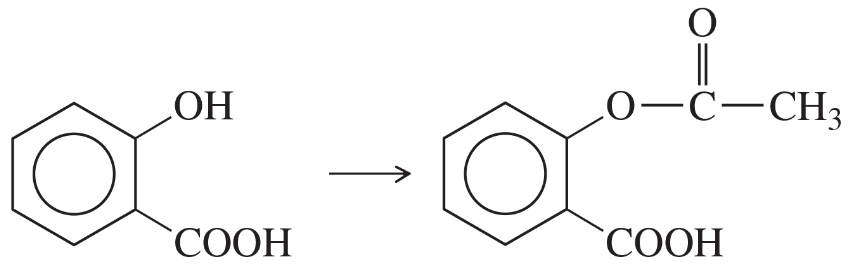
Problema 34a
Suggest the most appropriate reagent for each synthesis, and explain your choice.
(a)
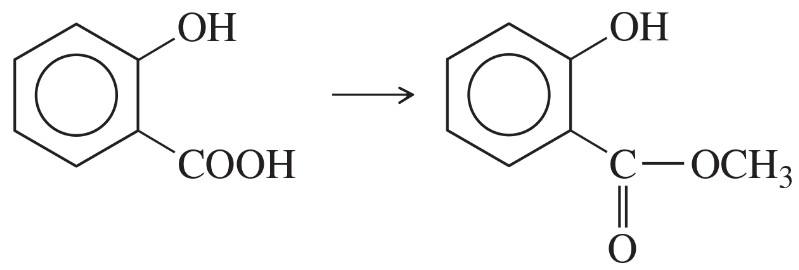
Problema 34b
Suggest the most appropriate reagent for each synthesis, and explain your choice.
(b)
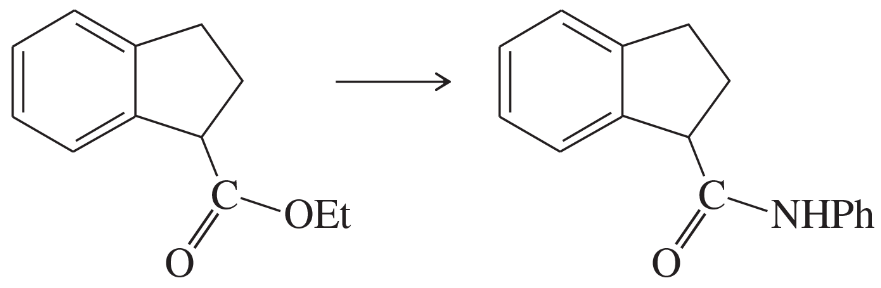
Problema 34c
Suggest the most appropriate reagent for each synthesis, and explain your choice.
(c)
Problema 34d
Suggest the most appropriate reagent for each synthesis, and explain your choice.
(d)
Problema 35a,b,c
Show how you would synthesize each compound, starting with an ester containing no more than eight carbon atoms. Any other necessary reagents may be used.
(a) Ph3C–OH
(b) (PhCH2)2CHOH
(c) PhCONHCH2CH3
Problema 35d,e,f
Show how you would synthesize each compound, starting with an ester containing no more than eight carbon atoms. Any other necessary reagents may be used.
(d) Ph2CHOH
(e) PhCH2OH
(f) PhCOOH
Problema 35i
Show how you would synthesize each compound, starting with an ester containing no more than eight carbon atoms. Any other necessary reagents may be used.
(i) HO–(CH2)8–OH
Problema 36a,b
Show how you would accomplish the following synthetic transformations. You may use any necessary reagents.
(a) N-ethylbenzamide → benzylethylamine
(b) ethyl benzoate → N-ethylbenzamide
Problema 36c,d
Show how you would accomplish the following synthetic transformations. You may use any necessary reagents.
(c) pyrrolidine → N-acetylpyrrolidine
(d) γ-aminobutyric acid → pyrrolidine
Problema 37
Show how you would accomplish the following syntheses using amides as intermediates. You may use any necessary reagents.
(a) benzoic acid → benzyldimethylamine
(b) pyrrolidine → N-ethylpyrrolidine
(c) cyclopentanecarboxylic acid → cyclopentanecarbonitrile
Problema 38a
Show how you would convert the following starting materials to the indicated nitriles:
(a) phenylacetic acid → phenylacetonitrile
Problema 38b
Show how you would convert the following starting materials to the indicated nitriles:
(b) phenylacetic acid → 3-phenylpropionitrile