Ch. 12 Nervous Tissue
Martini - Fundamentals of Anatomy & Physiology 11th Edition
Martini, Nath, Bartholomew11th EditionFundamentals of Anatomy & PhysiologyISBN: 9780136874089당신이 사용하는 게 아니라요?교과서 변경
12장, 문제 17

Describe the steps involved in the generation of an action potential.

검증된 단계별 안내
1
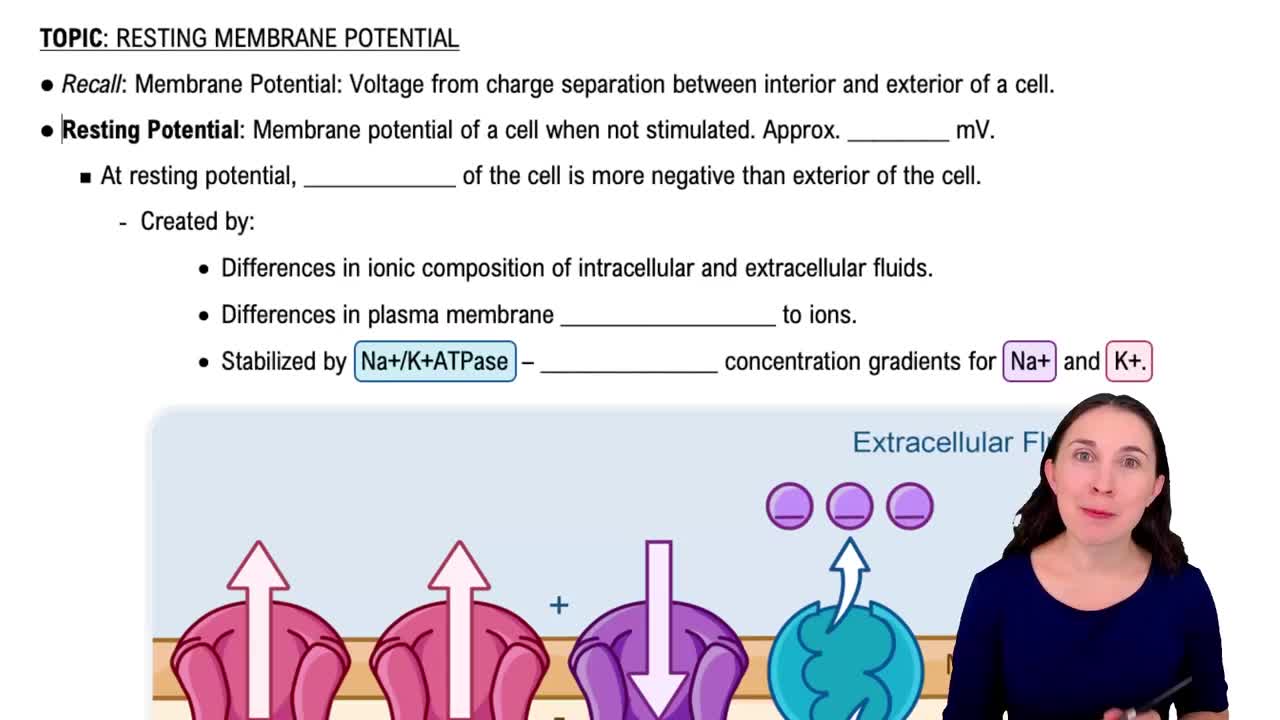
Step 1: Resting membrane potential is established, typically around -70 mV, due to the distribution of ions (mainly Na\(\textsuperscript{+}\) and K\(\textsuperscript{+}\)) across the neuron's membrane and the activity of the sodium-potassium pump.
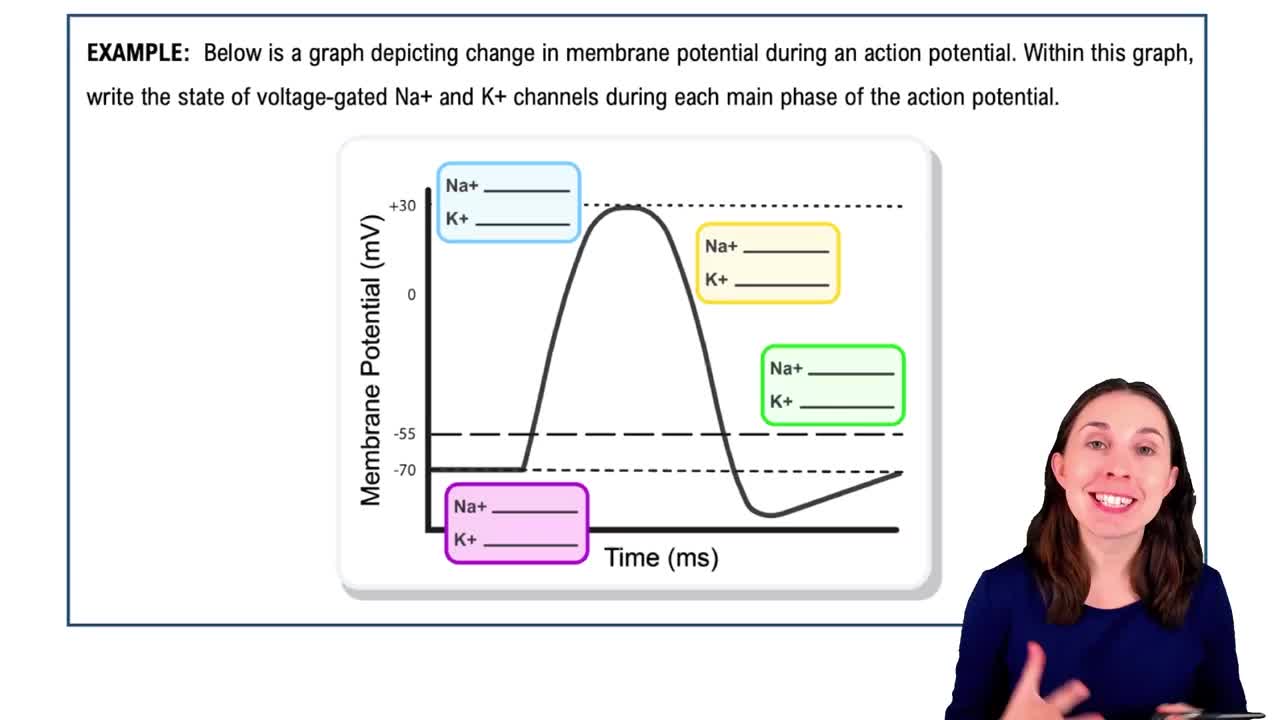
Step 2: A stimulus causes the membrane potential to reach the threshold level (usually around -55 mV), triggering the opening of voltage-gated sodium (Na\(\textsuperscript{+}\)) channels.
Step 3: Rapid depolarization occurs as Na\(\textsuperscript{+}\) ions rush into the cell, making the inside of the neuron more positive.
Step 4: At the peak of the action potential, voltage-gated sodium channels close and voltage-gated potassium (K\(\textsuperscript{+}\)) channels open, allowing K\(\textsuperscript{+}\) ions to exit the cell, initiating repolarization.
Step 5: The membrane potential returns toward the resting level (repolarization), sometimes overshooting to cause hyperpolarization, before the sodium-potassium pump and leak channels restore the resting membrane potential.

비슷한 문제에 대한 검증된 영상 답변:

이 영상 해법은 위 문제에 도움이 된다고 튜터들이 추천한 것입니다.
영상 길이:
5m
도움이 되었나요?

주요 개념

질문에 올바르게 답하기 위해 반드시 이해해야 하는 핵심 개념들은 다음과 같습니다.

Resting Membrane Potential

The resting membrane potential is the electrical charge difference across the neuron's membrane when it is not transmitting a signal, typically around -70 mV. It is maintained by ion gradients, primarily through the sodium-potassium pump and selective permeability to ions, setting the stage for action potential initiation.
추천 영상:
07:53
Resting Membrane Potential

Depolarization and Threshold

Depolarization occurs when a stimulus causes the membrane potential to become less negative, reaching a critical threshold (usually around -55 mV). This triggers voltage-gated sodium channels to open, allowing Na+ ions to rush into the cell, initiating the rising phase of the action potential.
추천 영상:
4:35
Transport Maximum (TM) & Renal Threshold

Repolarization and Hyperpolarization

After the peak of the action potential, voltage-gated sodium channels close and potassium channels open, allowing K+ to exit the cell, restoring the negative membrane potential (repolarization). Sometimes, the membrane potential becomes more negative than resting level (hyperpolarization) before stabilizing back to resting potential.
추천 영상:
02:36
Action Potentials Example 1