Identify and shade in the locations of all the ascending sensory tracts in the following diagram of the spinal cord.
Ch. 15 Sensory Pathways and the Somatic Nervous System
Martini, Nath, Bartholomew11th EditionFundamentals of Anatomy & PhysiologyISBN: 9780136874089당신이 사용하는 게 아니라요?교과서 변경
모든 교과서
Martini, Nath, Bartholomew 11th Edition
Ch. 15 Sensory Pathways and the Somatic Nervous System
문제 2
Martini, Nath, Bartholomew 11th Edition
Ch. 15 Sensory Pathways and the Somatic Nervous System
문제 215장, 문제 2
_______ receptors are normally inactive, but become active for a short time whenever there is a change in the modality that they monitor.
검증된 단계별 안내1
Understand the question is asking about a type of receptor that is usually inactive but activates briefly when there is a change in the stimulus it monitors.
Recall that sensory receptors can be classified based on how they respond to stimuli: some respond continuously, while others respond only to changes.
Identify that receptors which respond only to changes in stimulus intensity or modality are called 'phasic receptors' or 'adaptation receptors'.
Phasic receptors quickly adapt to a constant stimulus and become inactive, but they fire impulses when the stimulus changes, signaling new information.
Therefore, the answer involves recognizing that these receptors are called 'phasic receptors' because they are normally inactive but activate briefly upon changes in the monitored modality.

비슷한 문제에 대한 검증된 영상 답변:
이 영상 해법은 위 문제에 도움이 된다고 튜터들이 추천한 것입니다.
도움이 되었나요?
주요 개념
질문에 올바르게 답하기 위해 반드시 이해해야 하는 핵심 개념들은 다음과 같습니다.
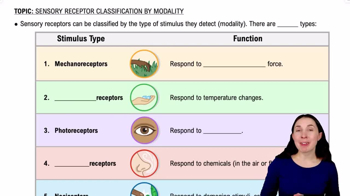
Receptor Modality
Receptor modality refers to the specific type of stimulus a sensory receptor is sensitive to, such as light, sound, or pressure. Each receptor is specialized to detect changes in its particular modality, enabling the nervous system to interpret different environmental signals accurately.
추천 영상:
Sensory Receptor Classification by Modality
Phasic Receptors
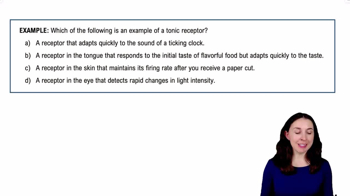
Phasic receptors are sensory receptors that remain inactive when a stimulus is constant but become active briefly when there is a change in the stimulus. They are important for detecting changes or new events in the environment, such as the onset or removal of a stimulus.
추천 영상:
Adaptation of Sensory Receptors Example 1
Sensory Adaptation
Sensory adaptation is the process by which sensory receptors reduce their response to a constant stimulus over time. This allows the nervous system to focus on new or changing stimuli, preventing overload from unchanging background information.
추천 영상:
Adaptation of Sensory Receptors Example 1
관련 실천
교과서 질문
724
views
교과서 질문
The larger the receptive field, the
(a) Larger the stimulus needed to stimulate a sensory receptor
(b) Fewer sensory receptors there are
(c) Harder it is to locate the exact point of stimulation
(d) Larger the area of the somatosensory cortex in the brain that deals with the area
(e) Closer together the receptor cells
1075
views
교과서 질문
Identify six types of tactile receptors located in the skin, and describe their sensitivities.
1064
views
교과서 질문
The CNS interprets information entirely on the basis of the
(a) Number of action potentials that it receives
(b) Kind of action potentials that it receives
(c) Line over which sensory information arrives
(d) Intensity of the sensory stimulus
(e) Number of sensory receptors that are stimulated
801
views