Ch. 17 The Special Senses
Martini - Fundamentals of Anatomy & Physiology 11th Edition
Martini, Nath, Bartholomew11th EditionFundamentals of Anatomy & PhysiologyISBN: 9780136874089당신이 사용하는 게 아니라요?교과서 변경
17장, 문제 22

Damage to the ampullary cupula of the lateral semicircular duct would interfere with the perception of
(a) The direction of gravitational pull
(b) Linear acceleration
(c) Horizontal rotation of the head
(d) Vertical rotation of the head
(e) Angular rotation of the head

검증된 단계별 안내
1
Understand the anatomy and function of the ampullary cupula: It is a gelatinous structure located within the ampulla of each semicircular canal in the inner ear, specifically involved in detecting rotational movements of the head.
Recall that the lateral semicircular duct (or canal) is oriented roughly horizontally and is primarily responsible for detecting horizontal (side-to-side) rotations of the head.
Recognize that the ampullary cupula bends in response to the movement of endolymph fluid within the semicircular canals during angular (rotational) acceleration, which stimulates hair cells to send signals about head rotation.
Differentiate between types of motion: gravitational pull and linear acceleration are detected by the otolith organs (utricle and saccule), not the semicircular canals; vertical rotation involves other canals (anterior and posterior).
Conclude that damage to the ampullary cupula of the lateral semicircular duct would specifically interfere with the perception of horizontal angular rotation of the head.

비슷한 문제에 대한 검증된 영상 답변:

이 영상 해법은 위 문제에 도움이 된다고 튜터들이 추천한 것입니다.
도움이 되었나요?

주요 개념

질문에 올바르게 답하기 위해 반드시 이해해야 하는 핵심 개념들은 다음과 같습니다.

Ampullary Cupula and Semicircular Canals

The ampullary cupula is a gelatinous structure located within the ampulla of each semicircular canal in the inner ear. It bends in response to fluid movement caused by head rotation, stimulating hair cells that send signals about angular motion to the brain.
추천 영상:
5:05
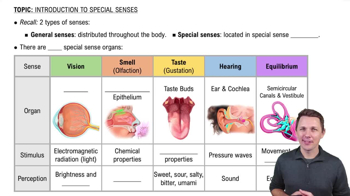
Special Senses

Function of the Lateral Semicircular Duct

The lateral semicircular duct specifically detects horizontal or yaw rotation of the head. When the head turns side to side, the fluid movement in this duct deflects the cupula, allowing the brain to perceive horizontal angular acceleration.
추천 영상:
5:16
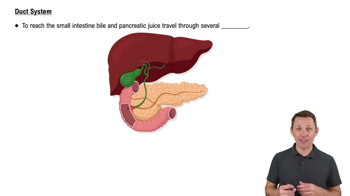
Duct System

Types of Motion Perceived by the Vestibular System

The vestibular system senses different motions: gravitational pull (static tilt), linear acceleration (straight-line movement), and angular rotation (head turning). Semicircular canals primarily detect angular rotation, while otolith organs detect gravity and linear acceleration.
추천 영상:
가이드 코스
3:00
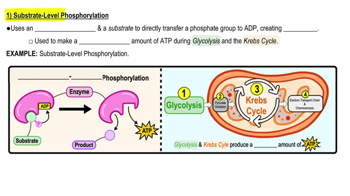
Types-Of-Phosphorylation-C-2-V-1
관련 실천
교과서 질문

What four cell populations make up the endocrine pancreas? Which hormone does each type of cell produce?

1054
views
교과서 질문

Your friend Shelly suffers from myopia (nearsightedness). You remember from your physics class that concave lenses cause light waves to spread or diverge and that convex lenses cause light waves to converge. What type of corrective lenses would you suggest to your friend?

(a) Concave lenses

(b) Convex lenses

723
views
교과서 질문

Juan tells his physician that he has been feeling dizzy, especially when he closes his eyes. He is asked to stand with his feet together and arms extended forward. As long as he keeps his eyes open, he exhibits very little movement. But when he closes his eyes, his body begins to sway a great deal, and his arms tend to drift together toward the left side of his body. Why does this occur?

773
views
교과서 질문

You are at a park watching some deer 35 feet away from you. A friend taps you on the shoulder to ask a question. As you turn to look at your friend, who is standing just 2 feet away, what changes would your eyes undergo?

746
views
교과서 질문

What are the three auditory ossicles in the middle ear, and what are their functions?

1416
views
교과서 질문

Displacement of stereocilia toward the kinocilium of a hair cell

(a) Produces a depolarization of the membrane

(b) Produces a hyperpolarization of the membrane

(c) Decreases the membrane permeability to sodium ions

(d) Increases the membrane permeability to potassium ions

(e) Does not affect the membrane potential of the cell

923
views