Ch. 19 Blood
Martini - Fundamentals of Anatomy & Physiology 11th Edition
Martini, Nath, Bartholomew11th EditionFundamentals of Anatomy & PhysiologyISBN: 9780136874089당신이 사용하는 게 아니라요?교과서 변경
19장, 문제 14

Which kinds of WBCs contribute to the body's nonspecific defenses?

검증된 단계별 안내
1
Step 1: Understand that white blood cells (WBCs) are part of the immune system and can be divided into those involved in specific (adaptive) immunity and nonspecific (innate) immunity.
Step 2: Recall that nonspecific defenses are the body's first line of defense and respond to pathogens in a general way, without targeting specific invaders.
Step 3: Identify the types of WBCs that participate in nonspecific defenses, such as neutrophils, eosinophils, basophils, monocytes/macrophages, and natural killer (NK) cells.
Step 4: Recognize the roles of these cells: neutrophils and macrophages perform phagocytosis to engulf pathogens; eosinophils combat parasites; basophils release histamine to promote inflammation; NK cells destroy infected or abnormal cells.
Step 5: Summarize that these WBCs contribute to the body's nonspecific defenses by providing rapid, generalized responses to a wide range of pathogens.

비슷한 문제에 대한 검증된 영상 답변:

이 영상 해법은 위 문제에 도움이 된다고 튜터들이 추천한 것입니다.

주요 개념

질문에 올바르게 답하기 위해 반드시 이해해야 하는 핵심 개념들은 다음과 같습니다.

White Blood Cells (WBCs)

White blood cells are immune system cells that protect the body against infections. They are divided into various types, each with specific roles in immune defense, including both nonspecific (innate) and specific (adaptive) immunity.
추천 영상:
가이드 코스
7:49
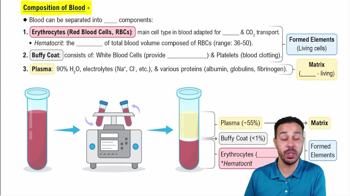
Composition of Blood

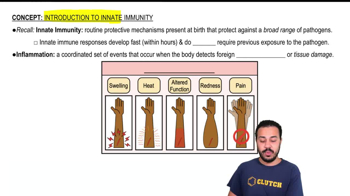
Nonspecific (Innate) Immune Defense

Nonspecific defenses are the body's first line of protection against pathogens, acting quickly and broadly without targeting specific invaders. This includes physical barriers, chemical signals, and immune cells that respond to a wide range of threats.
추천 영상:
가이드 코스
2:30
Innate Immunity

Types of WBCs Involved in Nonspecific Defense

Certain WBCs like neutrophils, macrophages, and natural killer cells play key roles in nonspecific defense by engulfing pathogens, destroying infected cells, and releasing chemicals to recruit other immune cells, providing rapid and generalized protection.
추천 영상:
가이드 코스
1:56
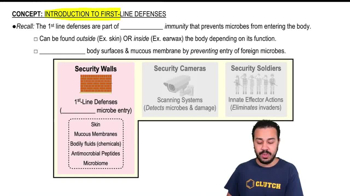
First-Line Defenses