
Ch. 2 The Chemical Level of Organization
Martini - Fundamentals of Anatomy & Physiology 11th Edition
Martini, Nath, Bartholomew11th EditionFundamentals of Anatomy & PhysiologyISBN: 9780136874089당신이 사용하는 게 아니라요?교과서 변경
2장, 문제 31

A certain reaction pathway consists of four steps. How would decreasing the amount of enzyme that catalyzes the second step affect the amount of product produced at the end of the pathway?

검증된 단계별 안내
1
Step 1: Understand that in a multi-step reaction pathway, each step is catalyzed by a specific enzyme, and the overall rate of product formation depends on the slowest (rate-limiting) step.
Step 2: Recognize that decreasing the amount of enzyme catalyzing the second step will reduce the rate at which this step occurs, potentially making it the new rate-limiting step if it was not already.
Step 3: Consider that when the second step slows down, intermediates before this step may accumulate, while steps after it receive fewer substrates, leading to a decrease in the overall flow through the pathway.
Step 4: Conclude that a slower second step will reduce the overall rate of product formation at the end of the pathway because the pathway cannot proceed faster than its slowest step.
Step 5: Summarize that decreasing the enzyme amount for the second step decreases the amount of final product produced, as the bottleneck created limits the throughput of the entire pathway.

비슷한 문제에 대한 검증된 영상 답변:

이 영상 해법은 위 문제에 도움이 된다고 튜터들이 추천한 것입니다.
영상 길이:
5m

주요 개념

질문에 올바르게 답하기 위해 반드시 이해해야 하는 핵심 개념들은 다음과 같습니다.

Enzyme Catalysis and Reaction Rate

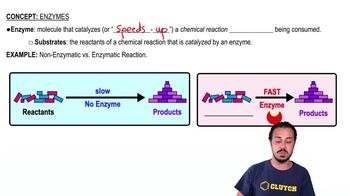
Enzymes speed up chemical reactions by lowering activation energy, increasing the reaction rate. Reducing enzyme concentration typically slows the catalyzed step, affecting the overall pathway speed.
추천 영상:

Rate-Limiting Step in Multi-Step Pathways

In a multi-step reaction, the slowest step controls the overall rate, known as the rate-limiting step. Decreasing enzyme in the second step may make it rate-limiting, reducing the final product formation.
추천 영상:
가이드 코스
2:39
Step 3: Vasodilation

Impact of Intermediate Accumulation and Flux

Slowing an intermediate step causes accumulation of upstream substrates and reduces downstream product flow. This bottleneck decreases the amount of final product produced in the pathway.
추천 영상: