

Ch. 2 The Chemical Level of Organization
Martini - Fundamentals of Anatomy & Physiology 11th Edition
Martini, Nath, Bartholomew11th EditionFundamentals of Anatomy & PhysiologyISBN: 9780136874089당신이 사용하는 게 아니라요?교과서 변경
2장, 문제 29

A sample that contains an organic molecule has the following constituents: carbon, hydrogen, oxygen, nitrogen, and phosphorus. Is the molecule more likely to be a carbohydrate, a lipid, a protein, or a nucleic acid?

검증된 단계별 안내
1
Identify the key elements present in the molecule: carbon (C), hydrogen (H), oxygen (O), nitrogen (N), and phosphorus (P).
Recall the typical elemental composition of the four major organic macromolecules: carbohydrates (C, H, O), lipids (C, H, O), proteins (C, H, O, N), and nucleic acids (C, H, O, N, P).
Note that carbohydrates and lipids do not contain nitrogen or phosphorus, while proteins contain nitrogen but not phosphorus, and nucleic acids contain both nitrogen and phosphorus.
Based on the presence of both nitrogen and phosphorus, conclude that the molecule is most likely a nucleic acid.
Understand that nucleic acids (DNA and RNA) are composed of nucleotides, which include a phosphate group (phosphorus), a nitrogenous base (nitrogen), and a sugar (carbon, hydrogen, oxygen).

비슷한 문제에 대한 검증된 영상 답변:

이 영상 해법은 위 문제에 도움이 된다고 튜터들이 추천한 것입니다.
영상 길이:
2m

주요 개념

질문에 올바르게 답하기 위해 반드시 이해해야 하는 핵심 개념들은 다음과 같습니다.

Elemental Composition of Biomolecules

Different classes of biomolecules have characteristic elemental compositions. Carbohydrates mainly contain carbon, hydrogen, and oxygen; lipids also primarily contain these three elements; proteins contain carbon, hydrogen, oxygen, and nitrogen; nucleic acids contain carbon, hydrogen, oxygen, nitrogen, and phosphorus. Recognizing these elemental patterns helps identify the type of molecule.
추천 영상:
가이드 코스
01:22
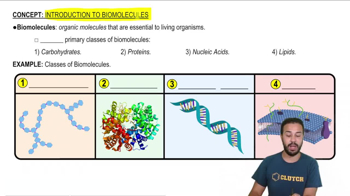
Introduction to Biomolecules

Role of Phosphorus in Biomolecules

Phosphorus is a key element found predominantly in nucleic acids and some lipids (like phospholipids). Its presence alongside nitrogen strongly suggests the molecule could be a nucleic acid, as proteins generally do not contain phosphorus. Understanding the significance of phosphorus helps narrow down the molecule's identity.
추천 영상:
가이드 코스
01:22
Introduction to Biomolecules

Distinguishing Biomolecule Classes by Functional Groups

Biomolecules differ in their functional groups and structures: carbohydrates have hydroxyl and carbonyl groups; lipids are mostly hydrophobic with long hydrocarbon chains; proteins contain amino and carboxyl groups; nucleic acids have phosphate groups and nitrogenous bases. Identifying these groups based on elemental composition aids in classifying the molecule.
추천 영상:
가이드 코스
06:04
Functional Groups
관련 실천