Ch. 22 The Lymphatic System and Immunity
Martini - Fundamentals of Anatomy & Physiology 11th Edition
Martini, Nath, Bartholomew11th EditionFundamentals of Anatomy & PhysiologyISBN: 9780136874089당신이 사용하는 게 아니라요?교과서 변경
22장, 문제 12

List the specific functions of each of the body's primary and secondary lymphoid tissues and organs.

검증된 단계별 안내
1
Identify the primary lymphoid tissues and organs, which include the bone marrow and thymus, and understand their main function in the immune system.
Explain that the bone marrow is responsible for the production and maturation of all blood cells, including the development of B lymphocytes (B cells).
Describe the thymus as the site where T lymphocytes (T cells) mature and undergo selection processes to ensure self-tolerance and functionality.
List the secondary lymphoid tissues and organs, such as lymph nodes, spleen, tonsils, and mucosa-associated lymphoid tissue (MALT), and recognize their role in immune response activation.
Explain that secondary lymphoid organs serve as sites where mature lymphocytes encounter antigens, become activated, proliferate, and initiate adaptive immune responses.

비슷한 문제에 대한 검증된 영상 답변:

이 영상 해법은 위 문제에 도움이 된다고 튜터들이 추천한 것입니다.

주요 개념

질문에 올바르게 답하기 위해 반드시 이해해야 하는 핵심 개념들은 다음과 같습니다.

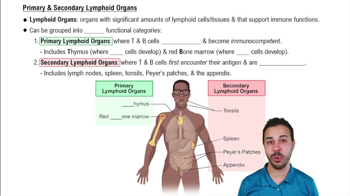
Primary Lymphoid Organs

Primary lymphoid organs, including the bone marrow and thymus, are responsible for the production and maturation of lymphocytes. Bone marrow generates all blood cells and matures B cells, while the thymus is where T cells mature and differentiate, preparing them for immune responses.
추천 영상:
가이드 코스
2:07
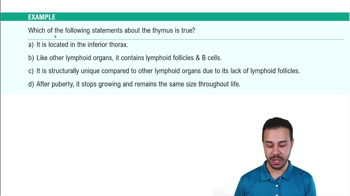
Primary Lymphoid Organs Example 1

Secondary Lymphoid Organs

Secondary lymphoid organs, such as lymph nodes, spleen, and mucosa-associated lymphoid tissue (MALT), serve as sites where mature lymphocytes are activated by encountering antigens. These organs facilitate immune surveillance, lymphocyte proliferation, and initiation of adaptive immune responses.
추천 영상:
가이드 코스
4:34
Primary & Secondary Lymphoid Organs

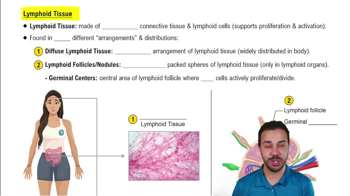
Functions of Lymphoid Tissues

Lymphoid tissues provide structural environments for immune cell interactions, antigen presentation, and lymphocyte activation. They filter lymph or blood to trap pathogens, support immune cell communication, and help generate effective immune responses to protect the body from infections.
추천 영상:
가이드 코스
4:55
Lymphoid Tissue