Ch. 23 The Respiratory System
Martini - Fundamentals of Anatomy & Physiology 11th Edition
Martini, Nath, Bartholomew11th EditionFundamentals of Anatomy & PhysiologyISBN: 9780136874089당신이 사용하는 게 아니라요?교과서 변경
23장, 문제 30

Doris has an obstruction of her right primary bronchus. As a result, how would the oxygen–hemoglobin saturation curve for her right lung compare with that for her left?

검증된 단계별 안내
1
Understand the oxygen–hemoglobin saturation curve: This curve represents the relationship between the partial pressure of oxygen (PO₂) and the percentage of hemoglobin saturated with oxygen. Factors like oxygen availability, carbon dioxide levels, pH, and temperature can shift the curve.
Recognize the impact of the obstruction: An obstruction in the right primary bronchus reduces airflow to the right lung, leading to decreased oxygen levels (hypoxia) in the alveoli of the right lung. This will affect the oxygen–hemoglobin saturation curve for the right lung.
Analyze the physiological response: In the right lung, reduced oxygen levels will lower the partial pressure of oxygen (PO₂). This causes hemoglobin to release oxygen more readily, shifting the oxygen–hemoglobin saturation curve to the right for the right lung. This shift indicates decreased oxygen saturation at a given PO₂.
Compare with the left lung: The left lung, which is unaffected, will maintain normal oxygen levels and a normal oxygen–hemoglobin saturation curve. The curve for the left lung will remain in its typical position, reflecting normal oxygen saturation at a given PO₂.
Summarize the comparison: The oxygen–hemoglobin saturation curve for the right lung will be shifted to the right due to lower oxygen levels, while the curve for the left lung will remain unchanged, reflecting normal oxygen saturation.

비슷한 문제에 대한 검증된 영상 답변:

이 영상 해법은 위 문제에 도움이 된다고 튜터들이 추천한 것입니다.
도움이 되었나요?

주요 개념

질문에 올바르게 답하기 위해 반드시 이해해야 하는 핵심 개념들은 다음과 같습니다.

Oxygen-Hemoglobin Saturation Curve

The oxygen-hemoglobin saturation curve illustrates the relationship between the partial pressure of oxygen (pO2) and the percentage of hemoglobin saturated with oxygen. This curve is sigmoidal in shape, indicating that hemoglobin's affinity for oxygen increases as more oxygen molecules bind. Understanding this curve is crucial for analyzing how changes in oxygen availability affect oxygen transport in the lungs.
추천 영상:
가이드 코스
7:52
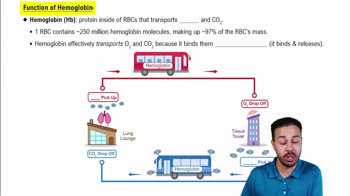
Function of Hemoglobin

Bronchial Obstruction

Bronchial obstruction refers to a blockage in the airways, which can significantly impair airflow and gas exchange in the affected lung. In Doris's case, the obstruction of the right primary bronchus would lead to reduced ventilation in the right lung, resulting in lower oxygen levels and potentially affecting the oxygen-hemoglobin saturation in that lung compared to the unobstructed left lung.
추천 영상:
10:41
Secondary Messengers

Ventilation-Perfusion (V/Q) Ratio

The ventilation-perfusion (V/Q) ratio is a measure of the efficiency of gas exchange in the lungs, representing the relationship between air reaching the alveoli (ventilation) and blood flow in the pulmonary capillaries (perfusion). An obstruction in one bronchus can lead to a mismatch in this ratio, causing the affected lung to have lower oxygen saturation due to inadequate ventilation compared to the well-ventilated lung.
추천 영상:
4:23
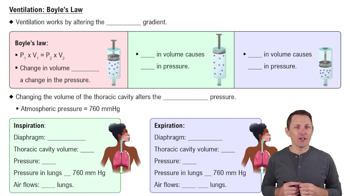
Ventilation: Boyle’s Law