
Ch. 23 The Respiratory System
Martini - Fundamentals of Anatomy & Physiology 11th Edition
Martini, Nath, Bartholomew11th EditionFundamentals of Anatomy & PhysiologyISBN: 9780136874089당신이 사용하는 게 아니라요?교과서 변경
23장, 문제 5

When the diaphragm and external intercostal muscles contract,
(a) Exhalation occurs.
(b) Intrapulmonary pressure increases.
(c) Intrapleural pressure decreases.
(d) The volume of the lungs decreases.
(e) The size of the thoracic cavity increases.

검증된 단계별 안내
1
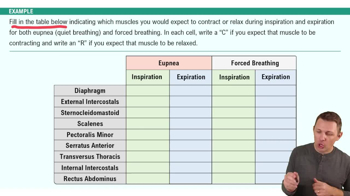
Step 1: Understand the role of the diaphragm and external intercostal muscles during breathing. When these muscles contract, they cause the thoracic cavity to change in size.
Step 2: Recall that contraction of the diaphragm moves it downward, and contraction of the external intercostal muscles lifts the rib cage upward and outward, both actions increasing the volume of the thoracic cavity.
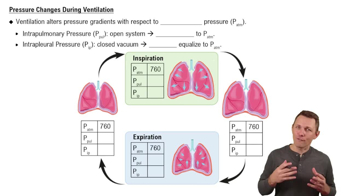
Step 3: Apply Boyle's Law, which states that pressure and volume are inversely related in a closed system. As the thoracic cavity volume increases, the pressure inside the lungs (intrapulmonary pressure) decreases relative to atmospheric pressure, allowing air to flow in (inhalation).
Step 4: Consider the intrapleural pressure, which is the pressure within the pleural cavity. When the thoracic cavity expands, the intrapleural pressure becomes more negative (decreases) to help keep the lungs inflated.
Step 5: Based on these physiological changes, identify which of the given options correctly describe the effects of diaphragm and external intercostal muscle contraction.

비슷한 문제에 대한 검증된 영상 답변:

이 영상 해법은 위 문제에 도움이 된다고 튜터들이 추천한 것입니다.
도움이 되었나요?

주요 개념

질문에 올바르게 답하기 위해 반드시 이해해야 하는 핵심 개념들은 다음과 같습니다.

Role of the Diaphragm and External Intercostal Muscles in Breathing

The diaphragm and external intercostal muscles are primary muscles involved in inspiration. When they contract, the diaphragm moves downward and the rib cage expands, increasing the thoracic cavity's volume and facilitating air intake into the lungs.
추천 영상:
가이드 코스
4:53
Ventilation Example 3

Intrapulmonary and Intrapleural Pressure Changes

Intrapulmonary pressure is the pressure inside the lungs, which decreases during inspiration to allow air inflow. Intrapleural pressure, the pressure within the pleural cavity, becomes more negative during muscle contraction, helping the lungs expand.
추천 영상:
가이드 코스
8:33
Pressure Changes During Ventilation

Relationship Between Thoracic Cavity Volume and Lung Volume

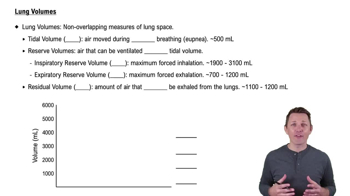
The size of the thoracic cavity directly affects lung volume. When the diaphragm and external intercostals contract, the thoracic cavity enlarges, causing lung volume to increase and air to flow in, which is essential for effective breathing.
추천 영상: