Ch. 23 The Respiratory System
Martini - Fundamentals of Anatomy & Physiology 11th Edition
Martini, Nath, Bartholomew11th EditionFundamentals of Anatomy & PhysiologyISBN: 9780136874089당신이 사용하는 게 아니라요?교과서 변경
23장, 문제 14

Which of the following does not occur in internal respiration?
(a) Oxygen diffuses from the blood to the interstitial spaces.
(b) Carbon dioxide diffuses from the interstitial spaces to the blood.
(c) Hemoglobin binds more oxygen.
(d) Bicarbonate ions are formed in red blood cells.
(e) Chloride ions diffuse into red blood cells as bicarbonate ions diffuse out.

검증된 단계별 안내
1
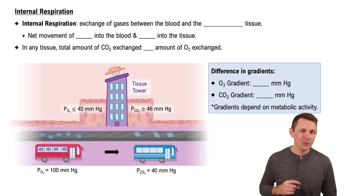
Step 1: Understand the concept of internal respiration. Internal respiration refers to the exchange of gases between the blood in systemic capillaries and the tissue cells. Oxygen moves from the blood to the tissues, and carbon dioxide moves from the tissues to the blood.
Step 2: Analyze option (a): 'Oxygen diffuses from the blood to the interstitial spaces.' This matches the definition of internal respiration, as oxygen leaves the blood to enter tissues.
Step 3: Analyze option (b): 'Carbon dioxide diffuses from the interstitial spaces to the blood.' This also matches internal respiration, where CO2 produced by tissues enters the blood.
Step 4: Analyze option (c): 'Hemoglobin binds more oxygen.' During internal respiration, hemoglobin actually releases oxygen to the tissues, so it does not bind more oxygen at this stage.
Step 5: Analyze options (d) and (e): Both describe processes related to CO2 transport in red blood cells during internal respiration, such as formation of bicarbonate ions and chloride shift, which do occur during internal respiration.

비슷한 문제에 대한 검증된 영상 답변:

이 영상 해법은 위 문제에 도움이 된다고 튜터들이 추천한 것입니다.
도움이 되었나요?

주요 개념

질문에 올바르게 답하기 위해 반드시 이해해야 하는 핵심 개념들은 다음과 같습니다.

Internal Respiration

Internal respiration refers to the exchange of gases between the blood and the body's tissues. Oxygen diffuses from the blood into the interstitial fluid and then into cells, while carbon dioxide moves from the cells into the blood. This process supports cellular metabolism by supplying oxygen and removing carbon dioxide.
추천 영상:
가이드 코스
5:20
Internal Respiration

Oxygen and Carbon Dioxide Transport in Blood

Oxygen is primarily transported bound to hemoglobin in red blood cells, releasing oxygen to tissues during internal respiration. Carbon dioxide is transported in three forms: dissolved in plasma, bound to hemoglobin, and as bicarbonate ions formed inside red blood cells through the enzyme carbonic anhydrase.
추천 영상:
04:19
Carbon

Chloride Shift (Hamburger Phenomenon)

The chloride shift is the movement of chloride ions into red blood cells as bicarbonate ions diffuse out into the plasma, maintaining electrical neutrality during carbon dioxide transport. This process mainly occurs in systemic capillaries during internal respiration to facilitate CO2 removal.
추천 영상:
01:26
Properties of Graded and Action Potentials Example 1