Ch. 27 Fluids & Electrolytes
Martini - Fundamentals of Anatomy & Physiology 11th Edition
Martini, Nath, Bartholomew11th EditionFundamentals of Anatomy & PhysiologyISBN: 9780136874089당신이 사용하는 게 아니라요?교과서 변경
26장, 문제 14

In a protein buffer system, if the pH increases:
(a) The protein acquires a hydrogen ion from carbonic acid
(b) Hydrogen ions are buffered by hemoglobin molecules
(c) A hydrogen ion is released and a carboxylate ion is formed
(d) A chloride shift occurs

검증된 단계별 안내
1
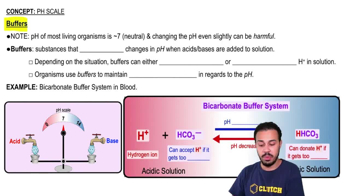
Step 1: Understand the role of protein buffer systems in maintaining pH balance. Proteins can act as buffers by either accepting or releasing hydrogen ions (H\_\{+\}) depending on the pH of the environment.
Step 2: Analyze what happens when the pH increases (becomes more basic). An increase in pH means fewer free hydrogen ions are present, so the protein buffer will tend to release hydrogen ions to counteract this change and maintain pH homeostasis.
Step 3: Recognize that when a protein releases a hydrogen ion, it often forms a negatively charged group, such as a carboxylate ion (\(\text{R-COO}\)^-), because the hydrogen ion was originally attached to a carboxyl group (\(\text{R-COOH}\)).
Step 4: Evaluate the other options: (a) acquiring a hydrogen ion would occur if pH decreased, (b) hemoglobin buffering hydrogen ions is related but not the direct response of the protein buffer system to increased pH, and (d) chloride shift is a process related to CO\_2 transport, not directly to protein buffering in response to pH increase.
Step 5: Conclude that the correct response to an increase in pH in a protein buffer system is the release of a hydrogen ion and formation of a carboxylate ion, corresponding to option (c).

비슷한 문제에 대한 검증된 영상 답변:

이 영상 해법은 위 문제에 도움이 된다고 튜터들이 추천한 것입니다.
도움이 되었나요?

주요 개념

질문에 올바르게 답하기 위해 반드시 이해해야 하는 핵심 개념들은 다음과 같습니다.

Protein Buffer System

The protein buffer system helps maintain pH balance in the blood by using amino acid side chains that can accept or donate hydrogen ions. When pH rises (becomes more basic), proteins can release hydrogen ions to lower the pH, stabilizing the environment.
추천 영상:
05:38
Buffers

Role of Hemoglobin in Buffering

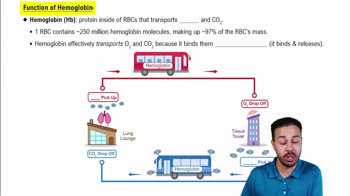
Hemoglobin acts as a buffer by binding hydrogen ions produced during carbon dioxide transport. This helps prevent large pH changes in the blood, as hemoglobin can reversibly bind H+ ions, especially in tissues where CO2 concentration is high.
추천 영상:
7:52
Function of Hemoglobin

Chloride Shift

The chloride shift is the exchange of bicarbonate ions and chloride ions across red blood cell membranes. It helps maintain ionic balance during CO2 transport but is not directly involved in protein buffering or immediate pH changes.
추천 영상:
06:07
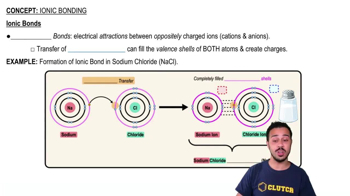
Ionic Bonds