Ch. 27 Fluids & Electrolytes
Martini - Fundamentals of Anatomy & Physiology 11th Edition
Martini, Nath, Bartholomew11th EditionFundamentals of Anatomy & PhysiologyISBN: 9780136874089당신이 사용하는 게 아니라요?교과서 변경
26장, 문제 12

The osmotic concentration of the ECF decreases if an individual gains water without a corresponding:
(a) Gain of electrolytes
(b) Loss of water
(c) Fluid shift from the ECF to the ICF
(d) All of these

검증된 단계별 안내
1
Step 1: Understand the key terms involved. ECF stands for extracellular fluid, and ICF stands for intracellular fluid. Osmotic concentration refers to the concentration of solutes (like electrolytes) in a fluid, which affects water movement across cell membranes.
Step 2: Recognize that osmotic concentration depends on the amount of solutes relative to the volume of water. If water is gained without adding solutes, the solute concentration will decrease because the same amount of solutes is now dissolved in a larger volume of water.
Step 3: Analyze each option to see how it affects osmotic concentration in the ECF when water is gained: (a) Gain of electrolytes would increase solutes, potentially maintaining or increasing osmotic concentration; (b) Loss of water would concentrate solutes, increasing osmotic concentration; (c) Fluid shift from ECF to ICF would reduce ECF volume and could affect concentration.
Step 4: Determine which condition prevents the decrease in osmotic concentration when water is gained. Since gaining water without gaining electrolytes dilutes the ECF, the osmotic concentration decreases unless there is a corresponding gain of electrolytes or loss of water to balance it.
Step 5: Conclude that the osmotic concentration of the ECF decreases if water is gained without a corresponding gain of electrolytes, making option (a) the correct choice.

비슷한 문제에 대한 검증된 영상 답변:

이 영상 해법은 위 문제에 도움이 된다고 튜터들이 추천한 것입니다.

주요 개념

질문에 올바르게 답하기 위해 반드시 이해해야 하는 핵심 개념들은 다음과 같습니다.

Osmotic Concentration and Osmolarity

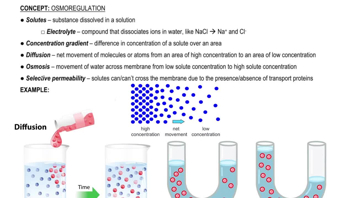
Osmotic concentration refers to the total concentration of solute particles in a solution, influencing water movement across membranes. In body fluids, osmolarity determines the direction of water flow between compartments like ECF and ICF to maintain balance.
추천 영상:
가이드 코스
07:59
Osmosis and Osmolarity

Extracellular Fluid (ECF) and Intracellular Fluid (ICF) Compartments

The body’s fluids are divided mainly into ECF and ICF. The ECF surrounds cells, while the ICF is inside cells. Changes in solute or water content in one compartment affect osmotic gradients, causing fluid shifts between ECF and ICF.
추천 영상:
2:39
Intracellular Receptors and Direct Gene Action Example 1

Electrolyte Balance and Water Movement

Electrolytes like sodium regulate osmotic pressure in the ECF. Gaining water without electrolytes dilutes ECF osmolarity, potentially causing water to move into cells. Maintaining electrolyte balance is essential to prevent osmotic imbalances and fluid shifts.
추천 영상:
가이드 코스
07:59
Osmosis and Osmolarity