뒤로
뒤로
문제 16
Find the zeros for each polynomial function and give the multiplicity of each zero. State whether the graph crosses the x-axis, or touches the x-axis and turns around, at each zero.
문제 19
In Exercises 19–24, (a) Use the Leading Coefficient Test to determine the graph's end behavior. (b) Determine whether the graph has y-axis symmetry, origin symmetry, or neither. (c) Graph the function.
문제 20
In Exercises 19–24, (a) Use the Leading Coefficient Test to determine the graph's end behavior. (b) Determine whether the graph has y-axis symmetry, origin symmetry, or neither. (c) Graph the function.
문제 25
In Exercises 25–26, graph each polynomial function.
문제 26
In Exercises 25–26, graph each polynomial function.
문제 27
Divide using long division.
문제 29
In Exercises 27–29, divide using long division.
문제 35
Use the Rational Zero Theorem to list all possible rational zeros for each given function.
문제 37
Use Descartes's Rule of Signs to determine the possible number of positive and negative real zeros for each given function.
문제 39
Use Descartes' Rule of Signs to explain why has no real roots.
문제 40
For Exercises 40–46, (a) List all possible rational roots or rational zeros. (b) Use Descartes's Rule of Signs to determine the possible number of positive and negative real roots or real zeros. (c) Use synthetic division to test the possible rational roots or zeros and find an actual root or zero. (d) Use the quotient from part (c) to find all the remaining roots or zeros.
문제 47
In Exercises 47–48, find an nth-degree polynomial function with real coefficients satisfying the given conditions. Verify the real zeros and the given function value. n = 3; 2 and 2 - 3i are zeros; f(1) = -10
문제 49
In Exercises 49–50, find all the zeros of each polynomial function and write the polynomial as a product of linear factors.
문제 51
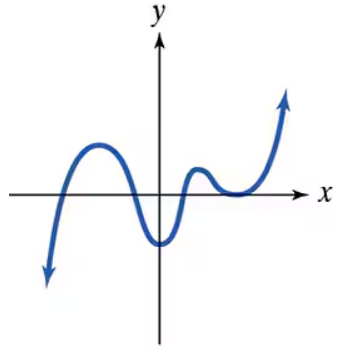
In Exercises 51–54, graphs of fifth-degree polynomial functions are shown. In each case, specify the number of real zeros and the number of imaginary zeros. Indicate whether there are any real zeros with multiplicity other than 1.
문제 55
Use transformations of f(x) = (1/x) or f(x) = (1/x2) to graph each rational function. g(x) = 1/(x + 2)2 - 1