 뒤로
뒤로
문제 59a
Using only the elements Ca, Cl, and Si, give formulas for the following. (a) An ionic compound
문제 59b
Using only the elements Ca, Cl, and Si, give formulas for the following. (b) A molecular compound with polar covalent bonds that obeys the octet rule and has no formal charges
- The dipole moment of BrCl is 0.518 D, and the distance between atoms is 213.9 pm. What is the percent ionic char-acter of the BrCl bond?
문제 60
- Why does the octet rule apply primarily to main-group elements, not to transition metals?
문제 64
- Which of the following substances contains an atom that does not follow the octet rule? (a) AlCl3 (b) PCl3 (c) PCl5 (d) SiCl4
문제 65
문제 68
Identify the correct electron-dot structure for XeF 5+ (a) (b) (c)
- Identify the third-row elements, X, that form the following ions. (a)
문제 72

- Identify the fourth-row elements, X, that form the following compounds. (a)
문제 73

- Acrylonitrile 1C3H3N2 is a molecule that is polymerized to make carpets and fabrics. The connections between atoms are shown.
문제 74
(d) Identify the shortest bond in the molecule.
- Which compound do you expect to have the stronger N-N bond, N2H2 or N2H4? Explain.
문제 76
- Calculate the energy change in kilojoules per mole when lithium atoms lose an electron to bromine atoms to form isolated Li+ and Br-ions. [The Ei for Li1g2 is 520 kJ/mol; the Eea for Br1g2 is -325 kJ/mol.] Will a lithium atom transfer an elec-tron to a bromine atom to form isolated Li+ 1g2 and Br-1g2 ions? Explain.
문제 80
- Ibuprofen 1C13H18O22, marketed under such brand names as Advil and Motrin, is a drug sold over the counter for treatment of pain and inflammation. Complete the structure of ibuprofen by adding hydrogen atoms and lone pairs where needed.
문제 83

문제 85b
Draw as many resonance structures as you can for the following nitrogen-containing compounds. Not all will obey the octet rule. Use curved arrows to depict the conversion of one structure into another. (b) NO
문제 85d
Draw as many resonance structures as you can for the following nitrogen-containing compounds. Not all will obey the octet rule. Use curved arrows to depict the conversion of one structure into another. (d) N2O3(ONNO2)
- Which of the following pairs of structures represent resonance forms, and which do not? (a)
문제 86
- The estimated lattice energy for CsF21s2 is +2347 kJ/mol. Use the data given in Problem 6.86 to calculate an overall energy change in kilojoules per mole for the formation of CsF21s2 from its elements. Does the overall reaction absorb energy or release it? In light of your answer to Problem 6.86, which compound is more likely to form in the reaction of cesium with fluorine, CsF or CsF2?
문제 87

- Benzene has the following structural formula.
문제 90
(b) Which statement best describes the carbon–carbon bonds in benzene? (i) Three carbon–carbon bonds are longer and weaker than the other three carbon–carbon bonds. (ii) All six carbon–carbon bonds are identical, and their length and strength are between a double and single bond. (iii) The length of carbon–carbon double bond switches back and forth between the length of a double and a single bond.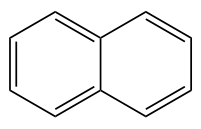
- Draw three resonance structures for sulfur tetroxide, SO4, whose connections are shown below. (This is a neutral mol-ecule; it is not a sulfate ion.) Assign formal charges to the atoms in each structure.
문제 91
- Some mothballs used when storing clothes are made of naphthalene (C10H8), which has the following incomplete structure.
문제 92
(a) Add double bonds where needed to draw a complete electron-dot structure.
- Four different structures (a), (b), (c), and (d) can be drawn for compounds named dibromobenzene, but only three different compounds actually exist. Explain. (a)
문제 93
(b)
(c)
(d)

- Use the following information plus the data given in Tables 6.2 and 6.3 to calculate the second electron affinity, Eea2, of oxygen. Is the O2-ion stable in the gas phase? Why is it stable in solid MgO? Heat of sublimation for Mg1s2 = +147.7 kJ/mol Bond dissociation energy for O21g2 = +498.4 kJ/mol Eea1 for O1g2 = -141.0 kJ/mol Net energy change for formation of MgO(s) from its elements = -601.7 kJ/mol
문제 96
문제 98
Assign formal charges to the atoms in the following structures. Which of the two do you think is the more important contributor to the resonance hybrid?(a)(b)
- Draw the resonance structure indicated by the curved arrows. Assign formal charges, and evaluate which of the two structures is a larger contributor to the resonance hybrid.
문제 102

- Propose structures for molecules that meet the following descriptions. (b) Contains an N atom that has one p bond and two s bonds
문제 110
- In the cyanate ion, OCN-, carbon is the central atom. (b) Which resonance structure makes the greatest contribution to the resonance hybrid? Which makes the least contribution? Explain.
문제 111
- The dichromate ion, Cr2O72-, has neither Cr¬Cr nor O¬O bonds. (a) Taking both 4s and 3d electrons into account, draw an electron-dot structure that minimizes the formal charges on the atoms.
문제 113
- Calculate an approximate heat of combustion for ethane (C2H6) in kilojoules by using the bond dissocation energies in Table 9.3. (The strength of the O'O bond is 498 kJ/ mol, and that of a C ' O bond in CO2 is 804 kJ/mol.)
문제 118
- Use the data in Table 9.3 to calculate an approximate ∆H° in kilojoules for the synthesis of hydrazine from ammonia: 2 NH3(g) + Cl2(g) → N2H4(g) + 2 HCl(g)
문제 119
- What is the difference between a covalent bond and an ionic bond?
문제 134
- The reaction S81g2 S 4 S21g2 has ΔH° = + 237 kJ (b) The average S ¬ S bond dissociation energy is 225 kJ/mol. Using the value of ΔH° given above, what is the S ' S double bond energy in S21g2?
문제 150