Ch.10 Acids and Bases
McMurry - Fundamentals of General, Organic, and Biological Chemistry 8th Edition
McMurry8th EditionFundamentals of General, Organic, and Biological ChemistryISBN: 9780134015187당신이 사용하는 게 아니라요?교과서 변경
10장, 문제 43

What is the difference between H+ and H3O+?

검증된 단계별 안내
1
Understand that H⁺ represents a hydrogen ion, which is essentially a proton. It is formed when a hydrogen atom loses its single electron, leaving only the nucleus (a single proton).
Recognize that H₃O⁺, known as the hydronium ion, is a more realistic representation of how H⁺ exists in aqueous solutions. Free protons (H⁺) are highly reactive and do not exist independently in water.
Learn that in water, H⁺ associates with a water molecule (H₂O) to form H₃O⁺. This process is represented by the reaction: H2O+HH3O.
Understand that H⁺ and H₃O⁺ are often used interchangeably in chemistry, but H₃O⁺ is the more accurate representation in aqueous solutions because it accounts for the interaction of the proton with water molecules.
Remember that the presence of H₃O⁺ in a solution is what determines its acidity. The concentration of H₃O⁺ (or equivalently H⁺) is used to calculate the pH of the solution.

비슷한 문제에 대한 검증된 영상 답변:

이 영상 해법은 위 문제에 도움이 된다고 튜터들이 추천한 것입니다.
영상 길이:
1m
도움이 되었나요?

주요 개념

질문에 올바르게 답하기 위해 반드시 이해해야 하는 핵심 개념들은 다음과 같습니다.

Proton (H⁺)

A proton, represented as H⁺, is a positively charged particle that is essentially a hydrogen atom stripped of its electron. It plays a crucial role in acid-base chemistry, as it is often associated with the behavior of acids in solution. In aqueous solutions, protons do not exist freely but are typically associated with water molecules.
추천 영상:
가이드 코스
01:46
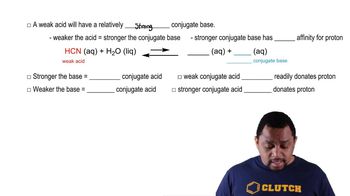
Acid and Base Strength Concept 4

Hydronium Ion (H₃O⁺)

The hydronium ion, denoted as H₃O⁺, forms when a proton (H⁺) interacts with a water molecule (H₂O). This ion is the actual species that exists in aqueous solutions when acids dissolve, as it represents the transfer of a proton to water. The presence of hydronium ions is fundamental in determining the acidity of a solution.
추천 영상:
가이드 코스
02:31
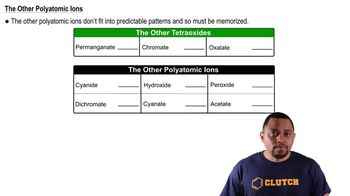
Polyatomic Ions

Acidity and pH

Acidity refers to the concentration of hydronium ions (H₃O⁺) in a solution, which directly influences the solution's pH level. The pH scale, ranging from 0 to 14, quantifies how acidic or basic a solution is, with lower values indicating higher acidity. Understanding the relationship between H⁺, H₃O⁺, and pH is essential for grasping concepts in acid-base chemistry.