뒤로
뒤로
문제 1c
Name the following pathways:
c. Pathway for synthesis of glucose from lactate
문제 4
Identify each step in glycolysis that is an isomerization.
문제 6a
In Figure 22.3, compare the starting compound (glucose) and the final product (pyruvate).
a. Which is oxidized to a greater extent?
문제 7
Use curved arrows (like those in Figure 22.3) to write an equation for the conversion of fructose to fructose 6-phosphate by ATP. At what step does fructose 6-phosphate enter glycolysis?
문제 9a
In alcoholic fermentation, each mole of pyruvate is converted to one mole of carbon dioxide and one mole of ethanol. In the process, about 50 kcal/mol (209 kJ/mol) of energy is produced. Under the most favorable conditions, more than one-half of this energy is stored as ATP.
a. What happens to the remaining energy produced in alcoholic fermentation?
문제 11
Pyruvate has three different fates. What are the three different molecules pyruvate is converted into? What conditions exist for the formation of each product?
문제 12
Glycolysis of one molecule of glucose produces 8 ATP molecules. How many ATP molecules are produced from glycolysis of 10 glucose molecules?
문제 19
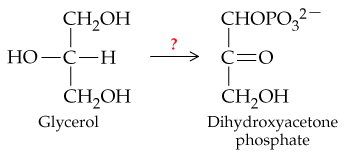
What two types of reactions convert glycerol to dihydroxyacetone phosphate?
문제 20
What is the purpose of the Cori cycle?
문제 23b
Glucose 6-phosphate is in a pivotal position in metabolism. Depending on conditions, glucose 6-phosphate follows one of several pathways. Under what conditions do the following occur?
b. Hydrolysis to free glucose
문제 23d
Glucose 6-phosphate is in a pivotal position in metabolism. Depending on conditions, glucose 6-phosphate follows one of several pathways. Under what conditions do the following occur?
d. Glycogenesis
문제 25b
Outline the conditions that direct pyruvate toward the following:
b. Conversion to ethanol and CO2
In what tissues or organisms is each pathway present?
문제 25c
Outline the conditions that direct pyruvate toward the following:
c. Conversion to lactate
In what tissues or organisms is each pathway present?
문제 25d
Outline the conditions that direct pyruvate toward the following:
d. Glucose synthesis (gluconeogenesis)
In what tissues or organisms is each pathway present?
문제 28
Name the molecules used for gluconeogenesis. What are the sources of these molecules? Under what conditions would gluconeogenesis occur?
문제 29
Fatty acids from stored triacylglycerols (fat) are not available for gluconeogenesis. Speculate why we do not have the enzymes to directly convert fatty acids into glucose. Plants (especially seeds) do have enzymes to convert fatty acids into carbohydrates. Why are they so lucky?
문제 30b
The pathway that converts glucose to acetyl-CoA is often referred to as an “aerobic oxidation pathway.”
(b) Thinking back to Chapter 20, where does molecular oxygen enter the picture?
문제 33
What are the major monosaccharide products produced by digestion of carbohydrates?
문제 34
What are the products of digestion of proteins, triacylglycerols, maltose, sucrose, lactose, and starch?
문제 36
What three products are formed from pyruvate under aerobic, anaerobic, and fermentation conditions?
문제 39
What is the major purpose of the pentose phosphate pathway? What cofactor (coenzyme) is used?
문제 42a
Which cells, liver, muscle, or brain, use the following pathways?
a. Glycolysis
문제 42b
Which cells, liver, muscle, or brain, use the following pathways?
b. Gluconeogenesis
문제 45a
Which glycolysis reactions are catalyzed by the following enzymes?
a. Pyruvate kinase
문제 45d
Which glycolysis reactions are catalyzed by the following enzymes?
d. Phosphoglycerate mutase
문제 46c
Review the 10 steps in glycolysis and then answer the following questions:
c. Which step is a dehydration?
문제 47a
How many moles of ATP are produced by phosphorylation in the following?
a. Glycolysis of 1 mol of glucose
문제 47b
How many moles of ATP are produced by phosphorylation in the following?
b. Aerobic conversion of 1 mol of pyruvate to 1 mol of acetyl-CoA
문제 47c
How many moles of ATP are produced by phosphorylation in the following?
c. Catabolism of 1 mol of acetyl-CoA in the citric acid cycle
문제 50
Lactate can be converted into pyruvate by the enzyme lactate dehydrogenase and the coenzyme NAD+. Write the reaction in the standard biochemical format, using a curved arrow to show the involvement of NAD+.