뒤로
뒤로
문제 1
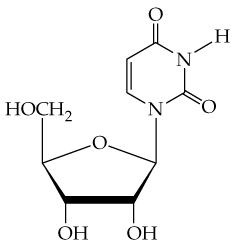
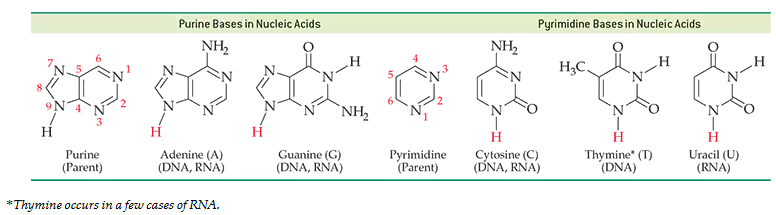
Name the nucleoside shown here. Copy the structure, and number the C and N atoms (refer to Table 26.1).
문제 5a
Write the full name of:
a. dUMP
문제 6
Name the bases in the pentanucleotide with the sequence G-A-U-C-A. Does this come from RNA or DNA? Explain.
문제 8a
Write the complementary sequence of bases for each DNA strand shown next.
a. 5′T-A-T-A-C-T-G 3′
문제 9
Draw the structures of adenine and uracil (which replaces thymine in RNA), and show the hydrogen bonding that occurs between them.
문제 10
Is a DNA molecule neutral, negatively charged, or positively charged? Explain.
문제 11a
DNA and RNA, like proteins, can be denatured to produce unfolded or uncoiled strands. Heating DNA to what is referred to as its “melting temperature” denatures it (the two strands of the double helix become separated). Why does a longer strand of DNA have a higher melting temperature than a shorter one?
문제 12
What are Okazaki fragments? What role do they serve in DNA metabolism?
문제 13
What is the difference between DNA polymerase and DNA ligase?
문제 14
What is the function of the spliceosome in hnRNA?
문제 15a
What mRNA base sequences are complementary to the following DNA template sequences? Be sure to label the 5′ and 3′ ends of the complementary sequences.
a. 5′ CAT GCT CTA CAG 3′
문제 16a
List possible codon sequences for the following amino acids.
a. Val
문제 17
Identify the amino acid for which the codon GAG codes, and what other codon could encode for this same amino acid?
문제 18a
What amino acids do the following sequences code for?
a. AUC
문제 20
What amino acid sequence is coded for by the mRNA base sequence CUC-AUU-CCA-UGC-GAC-GUA?
문제 23
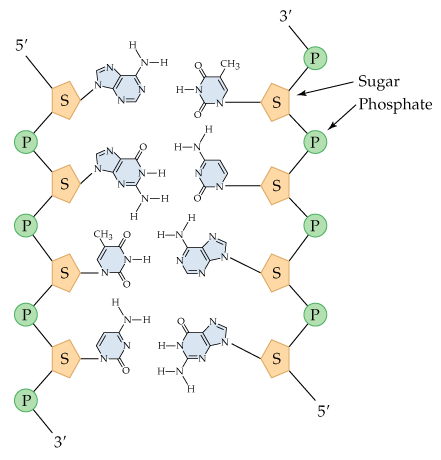
Copy the diagram and use dotted lines to indicate where hydrogen bonding occurs between the complementary strands of DNA. What is the sequence of each strand of DNA drawn (remember that the sequence is written from the 5′ to 3′ end)?
문제 24a
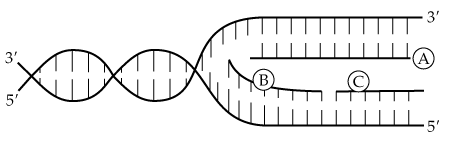
Copy the following simplified drawing of a DNA replication fork:
a. On the drawing, indicate the direction of synthesis of the new strand labeled A and the location of DNA polymerase on the strand.
문제 27a
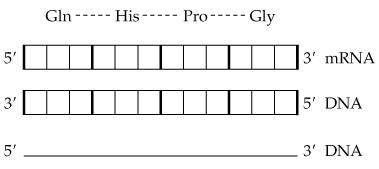
Gln-His-Pro-Gly is the sequence of a molecule known as progenitor thyrotropin-releasing hormone (pro-TRH). If we were searching for pro-TRH genes, we would need to know what sequence of bases in DNA we should be looking for. Use the following boxes to indicate answers to parts (a)–(d).
a. What RNA sequence could code for these four amino acids?
문제 28
What is the difference between a gene and a chromosome?
문제 29
What are the two major components of chromatin?
문제 30
What genetic information does a single gene contain?
문제 31
How many chromosomes are present in a human cell?
문제 32a
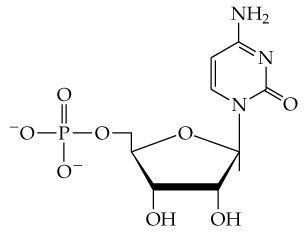
For the following molecule:
a. Label the three nucleic acid building blocks it contains.
문제 33
What are the sugars in DNA and RNA, and how do they differ?
문제 34a
What are the four major heterocyclic bases in DNA?
문제 35
What are the two structural types of bases in DNA and RNA? Which bases correspond to each type?
문제 38
What is the difference between the 3′ end and the 5′ end of a polynucleotide?
문제 39
Are polynucleotides synthesized 3′ to 5′ or 5′ to 3′?
문제 40
Draw the complete structure of uridine 5′- phosphate, one of the four major ribonucleotides.
문제 41
Draw the complete structure of the RNA dinucleotide U-C. Identify the 5′ and 3′ ends of the dinucleotide.